

Micro-SaaS is a small, niche software product built and run by one person that charges a monthly subscription to solve one specific problem. Non-technical founders in Canada can build micro-SaaS products using no-code platforms like Bubble, Glide, and Make, without writing a single line of code.
The most profitable opportunities in 2026 sit inside Canadian-specific niches: trades and contractor management, regulated health and wellness industries, bilingual client communication, and local service business automation.
Most founders spend under $1,000 to validate and launch, and the majority reach profitability within 12 months. This is not about building the next Shopify. It is about building a small, profitable software business that gives you control over your time, your income, and your direction.
Key Takeaway:
- Canada offers excellent opportunities for building profitable Micro-SaaS businesses due to strong government support, access to talent, stable economy, and growing demand for niche software solutions. [1]
- Key advantages include funding programs (SR&ED tax credits, grants), bilingual market potential, remote-friendly environment, and lower competition in vertical-specific tools compared to the US. [1]
- Promising niches include tools for small businesses in healthcare, real estate, agriculture, education, and compliance-heavy sectors; focus on solving local pain points like bilingual support or regulatory requirements. [2]
- Start lean with no-code/low-code tools, validate ideas quickly, leverage Canadian networks, and aim for recurring revenue models success stories show $5K–$50K+ MRR is achievable with focused execution. [2]
Bottom Line: Canada is a great environment for Micro-SaaS founders thanks to supportive policies, niche market needs, and lower competition focus on solving real local problems with simple, recurring-revenue tools for sustainable success.
What Is Micro-SaaS?
Micro-SaaS is a small, niche software product built for a specific audience that generates recurring revenue through subscriptions. It is typically run by one person or a small team, solves one specific problem, and does not require venture capital or a developer to build using today’s no-code platforms.
Can Non-Technical Founders Build SaaS Without Coding?
Yes. Non-technical founders can build fully functional SaaS products using no-code platforms like Bubble, Glide, and Make, which handle databases, user authentication, payment processing, and automated workflows without any programming required. Many successful micro-SaaS products generating $2,000 to $50,000 per month were built entirely without code.
Most people overthink SaaS. The founders who win are the ones who solve small, painful problems quickly and charge for it. That is the entire playbook.
Most non-technical founders who want to build something in tech hit the same wall. They have the idea, the domain knowledge, and the drive, but the moment “you need a developer” comes up, the momentum stalls. That wall is not as solid as it looks.
A new category of business has made that barrier almost irrelevant. Micro-SaaS: small, focused software products that solve one specific pain point for one specific audience, built and run by a single founder, often in weeks, and generating real recurring revenue without venture capital, a co-founder, or a line of code written. In Canada, where the SaaS ecosystem has largely been defined by the success stories coming out of Toronto, Waterloo, and Vancouver, the opportunity for smaller players is hiding in plain sight, in the underserved niches between the enterprise tools.
The numbers back this up. The global SaaS market reached $399 billion in 2024 and the micro-SaaS segment alone is growing at roughly 30% annually, projected to reach $59.6 billion by 2030. More relevant for founders working without a technical background: the barrier to entry has dropped so significantly that most successful micro-SaaS products today are built by people who did not write a single line of code.
This guide gives you a practical, grounded roadmap for finding, validating, and building a micro-SaaS business as a non-technical Canadian founder, using no-code tools that exist today.
Most people do not fail at SaaS because their idea was bad. They fail because they tried to build something too big, too fast, for too many people at once. The micro-SaaS model fixes all three of those mistakes by design.
15 Micro-SaaS Ideas for Non-Technical Founders in Canada (2026)
The best micro-SaaS ideas for non-technical Canadian founders are not broad. They are specific, localized, and built around real operational pain that existing tools ignore. Here are 15 validated, no-code-friendly opportunities across Canadian markets.
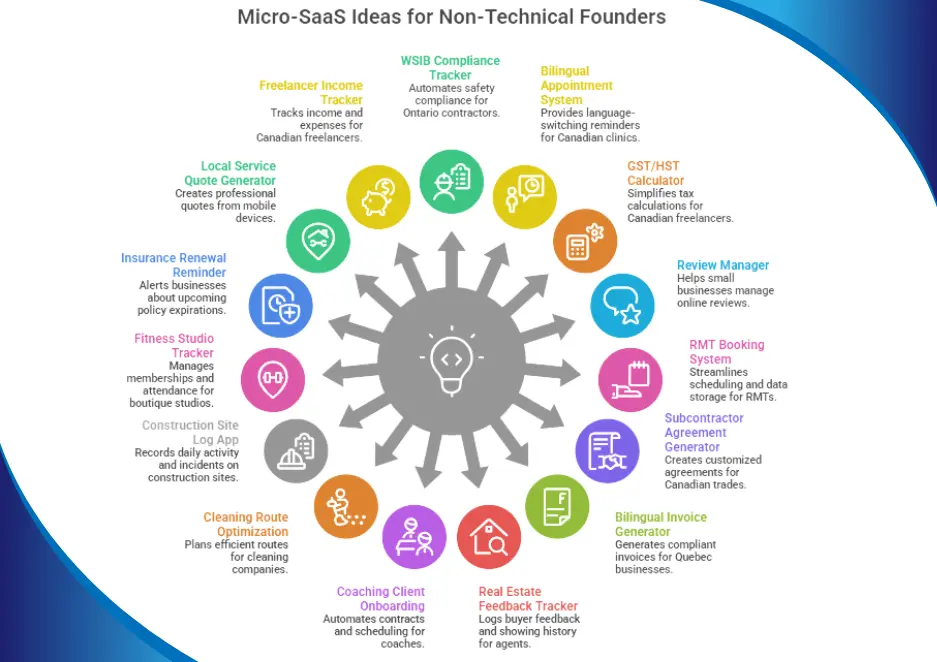
1. WSIB Compliance Tracker for Ontario Contractors
A tool that tracks safety certifications, renewal deadlines, and compliance documents for contractors operating under WSIB regulations. Contractors in this space are already paying for compliance consultants. A $49/month SaaS that automates what they currently do manually is an easy sell.
2. Bilingual Appointment Reminder System for Canadian Clinics
Automated SMS and email reminders for clinics, studios, and service providers that switch language based on client preference. Nearly every off-the-shelf reminder tool is English-only. This gap is your positioning.
3. GST/HST Calculator for Canadian Freelancers
A simple SaaS that calculates tax obligations based on province, income thresholds, and business type. Canada’s multi-rate tax structure makes this genuinely confusing, and the market of self-employed Canadians who need it is enormous.
4. Review Manager for Single-Location Canadian Businesses
A tool that helps small businesses collect, respond to, and automate Google reviews without enterprise pricing. BrightLocal charges $44/month per location for multi-location businesses. The single-location owner is almost entirely underserved.
5. Booking and Intake System for Canadian RMTs
All-in-one scheduling, intake forms, and secure client data storage designed specifically for Canadian RMTs and compliant with PIPEDA. Generic tools like Jane App are powerful but expensive. A stripped-down, purpose-built tool for solo practitioners at half the price would win on simplicity alone.
6. Subcontractor Agreement Generator for Canadian Trades
Generate legally structured agreements customized by province and project type, with standard clauses for common trades scenarios. This is something tradespeople currently pay lawyers or download from sketchy template sites to handle.
7. Bilingual Invoice Generator for Quebec Businesses
Create compliant French and English invoices instantly for Quebec-based entrepreneurs and professionals. Most invoicing tools do not account for Quebec-specific business naming conventions or the province’s distinct requirements.
8. Real Estate Showing Feedback Tracker
A lightweight CRM for agents to log buyer feedback, track showing history, and follow up automatically. Most agents use note-taking apps or spreadsheets. A $29/month tool that does this one job well for a commission-based professional is a no-brainer adoption.
9. Coaching Client Onboarding and Contract Tool
Automates contracts, intake forms, and session scheduling for coaches and consultants in one place. This niche alone, given the growth of the Canadian coaching industry, could sustain a healthy solo founder business for years.
10. Cleaning Business Route Optimization Tool
Helps small residential cleaning companies plan daily job routes and reduce dead travel time between clients. Most cleaning companies with five or more clients are routing manually. Even a 20-minute daily saving is worth $30/month to a busy operator.
11. Construction Site Daily Log App
A lightweight tool for site supervisors to log activity, incidents, weather conditions, and worker hours, exportable for client reports. This category is dominated by expensive enterprise platforms that price out small contractors entirely.
12. Fitness Studio Membership and Attendance Tracker
Simple membership management, class bookings, and attendance logging for boutique studios that find Mindbody too expensive and too complex. The gap between free tools and enterprise software is where micro-SaaS lives.
13. Insurance Renewal Reminder SaaS for Small Businesses
Tracks policy expiry dates across multiple business insurance types and sends automated renewal alerts. Small business owners routinely miss renewals. A simple tracker that costs less than one missed renewal saves itself every month.
14. Local Service Quote Generator
Helps plumbers, electricians, landscapers, and other tradespeople create fast, professional quotes from mobile, without needing a laptop or office. Most tradespeople quote verbally or by text. A professional PDF quote from a phone, in under two minutes, is a genuine upgrade.
15. Freelancer Income and Expense Tracker
A lightweight accounting tool built around Canadian tax categories, T2125 reporting, and HST tracking. Most generic expense trackers require manual reconfiguration for Canadian tax law. Purpose-built means less friction and a loyal user base that stays because alternatives do not fit.
The best idea for you sits at the intersection of three things: a problem you have personally experienced, customers who are already paying for a workaround, and a solution that can be built using no-code tools in under 12 weeks. If your idea clears all three, it is worth validating.
What Is Micro-SaaS and Why Canada Is a Perfect Market for It
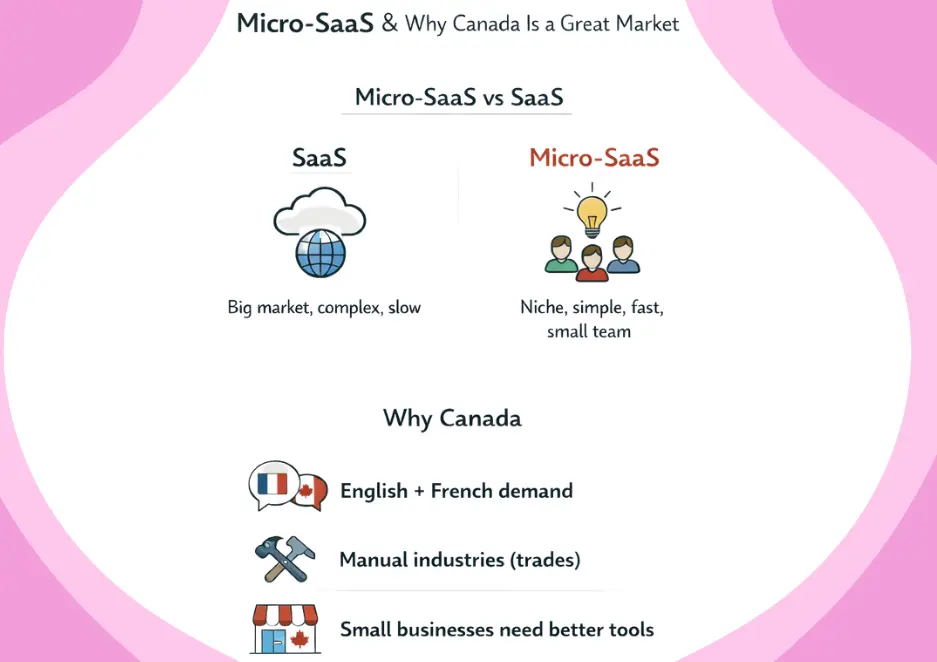
Micro-SaaS vs. Regular SaaS
Traditional SaaS is built to serve large, horizontal markets. Salesforce serves every sales team. Slack serves every team, full stop. Micro-SaaS takes the opposite approach: it serves a precise audience with a precise solution and charges a modest monthly subscription to do it well. No sprawling feature sets. No giant engineering teams. No investors breathing down your neck.
Micro-SaaS products typically run with one to five people, generate between $50,000 and $3 million annually at scale, and reach profitability far faster than their larger counterparts. The focused scope means a non-technical founder can build and launch in four to twelve weeks using no-code tools rather than six to twenty-four months with a development team.
Why Canada Creates Unique Advantages
Canada has several market characteristics that create real openings for niche software founders. The country’s bilingual requirements around English and French create compliance and communication challenges that most US-built tools ignore. Canada’s construction and trades sector, one of the country’s largest employers, runs almost entirely on spreadsheets and phone calls. And Canadian small businesses are statistically underserved by software built specifically for their regulatory environment, tax structures, and provincial compliance requirements.
Add to this the fact that vertical SaaS is currently growing two to three times faster than horizontal SaaS globally, and the pattern becomes clear. Generic horizontal tools are losing ground to specialized solutions built for specific industries. Canada offers an entire shelf of industries where that specialized solution does not yet exist.
Data and Findings: What Micro-SaaS Actually Pays
Before you picture quitting your job next month, here is what the data actually shows, based on a 2025 analysis of over 1,000 micro-SaaS products:
| Metric | Benchmark (2025) |
| Median MRR | $500/month across 1,000+ products |
| Profitability rate | 95% reach profitability within 12 months |
| Sustainability zone | 18% reach $1,000-$5,000 MRR (covers costs, buys decision time) |
| Profit margins | 41%+ average; top quartile founders hit 80%+ |
| Time to first dollar | Median 3 months |
| Launch cost | Under $1,000 for most founders using no-code tools |
| AI-native products | Grow 2x faster than non-AI products in same niche |
The realistic picture is this: 70% of micro-SaaS founders earn under $1,000 a month. A meaningful portion of those are still in the validation or early-growth phase. The founders who succeed share a clear pattern: they solve a problem they personally understand, they validate before building, and they focus on one narrow niche rather than chasing everyone. According to Freemius’s 2025 State of Micro-SaaS report, solo founders make up 45.7% of all SaaS makers, and many operate profitable businesses with $4,000-$5,000 MRR, enough to fund ongoing development without ever touching external capital.
The ceiling is real too. Carrd, built by a solo founder, reached $1.5 million in annual recurring revenue with a team of one. Bannerbear crossed $991,000 ARR. These are lifestyle businesses designed for freedom, not unicorn companies built for acquisition. That distinction matters. If your goal is control over your time and a meaningful recurring income, this model is built for that.
Five High-Opportunity Micro-SaaS Niches for Canadian Founders
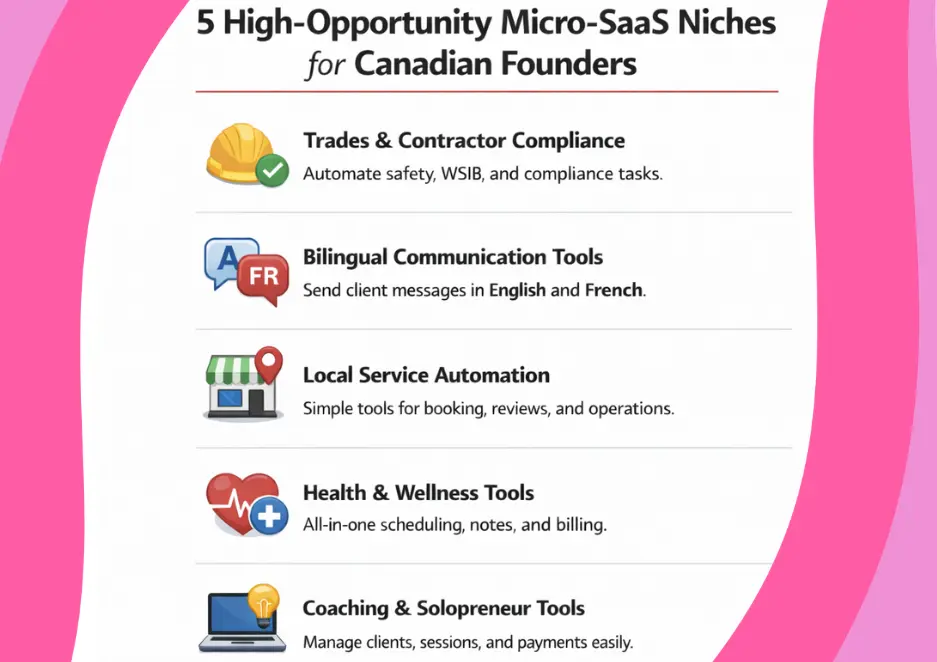
1. Trades and Contractor Compliance Tools
Canada’s construction sector is massive and manually operated. Contractors juggle province-specific safety requirements, WSIB compliance documentation, subcontractor agreements, and job site scheduling across tools that were never built to talk to each other. A simple SaaS that centralizes compliance checklists, sends automated renewal reminders, and generates documentation for specific provincial requirements has an obvious and willing customer base. Most contractors in this space have budget, recurring needs, and zero alternatives purpose-built for them.
2. Bilingual Client Communication Tools
English and French bilingual communication is not just a cultural nicety in Canada. For regulated industries like healthcare, legal services, and financial advising, it is often a compliance requirement. Yet most off-the-shelf client communication tools force businesses to manage translation manually or maintain two separate workflows. A micro-SaaS that automates bilingual client messaging, appointment reminders, or intake forms for a single regulated industry could charge a premium and face virtually no direct competition from US-built alternatives.
3. Local Service Business Automation
The local service business category, salons, fitness studios, cleaning companies, and repair shops, is chronically underserved by software that actually fits how they operate. Most enterprise tools are too expensive and too complex. Most cheap tools are too generic. According to BrightLocal’s market data, single-location businesses are largely ignored by solutions priced and built for multi-location chains. The opportunity: one tool, one vertical, one province. Build the review management tool for Halifax cleaning companies, or the booking system for Quebec City fitness studios. Niche down further than feels comfortable. That is precisely where the revenue hides.
4. Health and Wellness Practitioner Tools
Solo practitioners, naturopaths, occupational therapists, mental health counselors, and nutritionists run practices that generate significant revenue but operate with cobbled-together digital infrastructure. They need scheduling, intake forms, session notes, billing, and client communication in one place. Existing enterprise healthcare platforms are priced for clinics, not solo practices. A PIPEDA-compliant (Canada’s privacy law equivalent to HIPAA) SaaS designed for a single practitioner type, say, registered massage therapists in Ontario, with exactly the features they need and none they do not, would command strong subscription loyalty and low churn. The coaching for tech startups in the Ontario ecosystem alone reflects how much demand exists for tools that fit the actual structure of Canadian professional practice.
5. Solopreneur and Coaching Business Back-Office Tools
This one sits close to home. Canada’s coaching, consulting, and training industry has exploded in recent years, and most practitioners in it are managing client onboarding, contracts, session booking, invoicing, and follow-up through a patchwork of five different apps. A micro-SaaS that unifies even two of those workflows for a specific practitioner type (NLP coaches, career consultants, executive coaches) and charges $49 to $99 a month would be solving a genuine daily pain point for a community already comfortable paying for digital tools.
The No-Code Stack: Tools That Let You Build Without a Developer
No-code platforms have matured significantly. What required a developer team five years ago can now be built by a non-technical founder in weeks. Here is a practical comparison built specifically for non-technical SaaS founders, including the factor most guides skip: learning curve.
| Tool | Best For | Monthly Cost | Learning Curve | Verdict |
| Bubble | Full-stack SaaS apps, dashboards, user auth, databases | Free – $349+ | Steep. Plan 2-4 weeks to get comfortable. | Most powerful for true SaaS products. Best if you can commit to learning it. |
| Glide | Fast-ship apps from spreadsheets, internal tools | Free – $99+ | Gentle. Most founders ship in days. | Best starting point for non-technical founders who want results fast. |
| Make (Integromat) | Workflow automation, connecting existing tools | $12 – $300+ | Moderate. Visual flows are intuitive once you understand triggers. | Ideal for automating multi-step processes without a full app. |
| Webflow | Marketing sites, landing pages, CMS content | $23 – $235+ | Moderate for designers, steep for others. | Use this for your product’s marketing site, not the app itself. |
| Airtable | Database-first tools, simple CRMs, client tracking | Free – $54+/user | Low. Feels like a smarter spreadsheet from day one. | Strong starting point for data-heavy tools. Pair with Glide for a clean front-end. |
A practical starting recommendation for most Canadian non-technical founders: use Glide or Airtable to validate your idea and serve your first ten customers, then graduate to Bubble if the product demands more complexity. The goal is to ship, not to architect. As one founder community puts it, the best tool is the one you will actually finish.
The 5-Step LAUNCH Framework for Non-Technical Founders
After working with founders across industries for more than 20 years, I have seen the same pattern derail otherwise solid ideas, not a lack of tools, but a lack of a clear, repeatable process. The LAUNCH Framework gives non-technical founders a structured path from idea to paying customer.
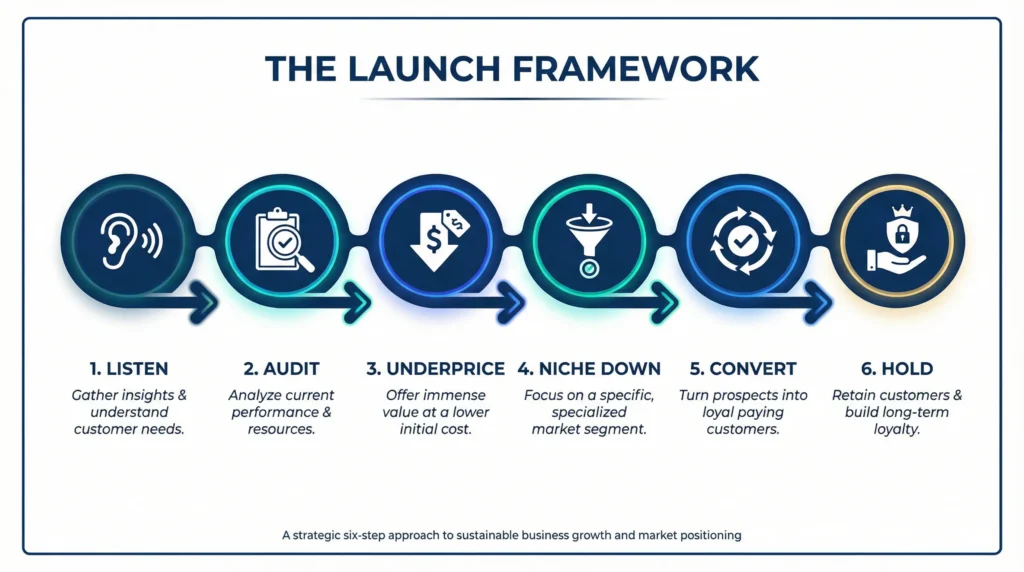
L – Listen Before You Build
The most expensive mistake in micro-SaaS is building something before you know people will pay for it. Spend your first two to three weeks entirely in communities: Reddit threads, LinkedIn groups, local industry forums, Facebook groups for tradespeople or practitioners in your target niche. You are not selling. You are listening for the phrase that repeats: “I wish there was a tool that…” or “I just use spreadsheets for that because nothing else fits.” That phrase is your product.
A – Audit the Competitive Landscape
Search for every tool that partially solves the problem you heard. List them. Note their pricing, their reviews, and critically, the gaps in their one-star reviews. Those gaps are your differentiation. If every negative review says “too complex for a small team” or “no French language support”, you have just found your positioning. Read more about why small businesses fail to grow and you will recognize this pattern immediately: they choose tools that were never built for them.
U – Underprice to Get In the Door
Your first ten customers are not revenue. They are research and referrals. Price your beta at 50-70% below what you eventually plan to charge. Offer a lifetime deal to your first cohort. The goal is to get real people using the product so you can see what breaks, what delights, and what they actually need. Most successful micro-SaaS founders acquired their first customers through direct outreach, not advertising. Join the community first, build in public second, sell third.
N – Niche Down Further Than Feels Comfortable
This is the step most founders resist. “But if I build it for dental practices, I am missing chiropractors.” No. You are building something that dental practices will actually buy, recommend to colleagues, and stick with. Niche specificity is not a limitation. It is your unfair advantage against tools built for everyone. Darren came to James R. Elliot not because he lacked tools or resources, but because something was keeping him stuck, a belief that the gap between where he was and what he wanted was too wide to bridge. The same internal block shows up for aspiring founders who keep broadening their idea until it becomes unlaunchable. Clarity of niche is clarity of action. Narrow the scope, and the path forward becomes obvious.
C – Convert With a Fake Door First
Before you build a single screen, create a landing page describing the product and what it does. Add a “Join the Waitlist” or “Request Early Access” button. Drive 50 to 100 people from your target community to that page. If fewer than 20 sign up, the idea needs refinement. If you get 20 or more signups and several ask about pricing, you have demand. According to e-dimensionz.com, the biggest mistake non-technical founders make is jumping straight to building. The fake door test is free, fast, and brutally honest.
H – Hold the Scope
Once you start building, your users will ask for features. Resist the pull to add everything. The discipline of saying “not yet” to feature requests is what keeps a micro-SaaS lean, profitable, and maintainable by one person. Build the one thing you promised. Get it right. Then expand. This connects directly to goal setting for business growth: the founders who scale sustainably are rarely the ones who built the most features fastest. They are the ones who stayed focused the longest.
Who Should Start a Micro-SaaS Business?
You are a strong candidate if you check several of these:
- You have three or more years of experience inside a specific industry (trades, healthcare, coaching, legal, or real estate) and understand its daily operational frustrations intimately.
- You are comfortable spending 10 to 15 hours a week on a project for 6 to 12 months before expecting meaningful revenue.
- You have encountered a recurring problem in your field that existing tools either ignore or solve poorly.
- You are willing to talk to potential customers before writing a single line of code or setting up a single workflow.
- You want a business model built on recurring income, low overhead, and high autonomy, not a high-growth startup trajectory.
For more on how NLP for entrepreneurs connects directly to founder confidence and decision-making under uncertainty, that foundation matters here more than most founders expect.
Who Should Avoid It (For Now)?
This model is not the right fit for everyone at every stage:
- You are expecting revenue within 60 days. The median time to first dollar is three months, and to $1,000 MRR, often 12 to 18 months.
- You want to build a broad, horizontal tool for everyone. The economics of micro-SaaS depend on niche focus and high retention, which requires genuine specificity.
- You are not willing to do customer development. If talking to potential users feels uncomfortable, the failure rate rises sharply.
- You are looking for a side income that runs itself from day one. The early months require consistent attention to customer feedback and product iteration.
That last point is worth sitting with. The barrier for most non-technical founders is not the code, the tools, or even the money. It is the mental gap between where they are and where the business needs to be. That gap is real, and it can be closed with the right support, the right framework, and the right belief in the domain expertise you already have.
Micro-SaaS Idea Validation Checklist
Before you build a single screen, run your idea through this checklist. If you answer yes to four or more, your idea is worth pursuing.
- Have you personally experienced this problem in a professional context?
- Are people in your target market already paying for a workaround (spreadsheets, consultants, manual processes)?
- Can you explain the value of your product in one sentence to someone in the industry?
- Can it be built using no-code tools in under 12 weeks without hiring a developer?
- Can you identify at least 20 people willing to join a waitlist before you build?
- Is there a clear, recurring reason customers would pay monthly rather than once?
- Four or more yes answers signal real demand. Three or fewer means the idea needs refinement before you invest time in building.
If one of the ideas above stood out to you, do not move on yet. Write it down. Put it through this checklist. That is how real SaaS businesses start: not with a perfect plan, but with one specific problem worth solving.
Real Micro-SaaS Examples and What You Can Learn
The success stories that matter are not the ones on magazine covers. They are the ones built by one person with a laptop, a clear niche, and the discipline to stay focused. Here are three that every aspiring micro-SaaS founder should study.
Carrd: Simplicity as a Competitive Strategy
Carrd is a one-page website builder created by a solo founder. It launched with a generous free tier, charged $19 to $49 annually for premium features, and reached $1.5 million in annual recurring revenue with a team of one. The lesson: picking the simplest possible version of a well-understood problem and doing it better than anyone else is a viable strategy. Carrd did not try to compete with Squarespace on features. It competed on speed and simplicity, and won a loyal niche.
Bannerbear: Niche Automation with a Clear ROI
Bannerbear automates the generation of marketing images, social media graphics, and visual content through an API. Built by a solo founder and reaching over $990,000 in annual recurring revenue, it succeeded by solving one specific operational pain for marketing teams and developers: the repetitive creation of image variants. The lesson: if something gets done manually every single day inside a specific workflow, it is worth automating. The narrower the automation, the clearer the ROI, and the easier it is to sell.
Nomad List: Community-First SaaS
Nomad List is a database and community platform for location-independent workers. Built by Pieter Levels and generating over $5 million annually, it started as a public spreadsheet before becoming a paid product. The lesson: if you can build a community around a shared identity before you build a paid product, the conversion becomes almost frictionless. For Canadian founders, this model translates directly: build the community for Ontario contractors or Quebec bilingual professionals first, then launch the tool they already trust you to build.
Ready to Find Your Niche?
The opportunity for non-technical Canadian founders in micro-SaaS has never been more accessible. The tools are ready. The niches are open. The question is whether you are willing to trust your domain expertise enough to act on it.
If you want to build the clarity, confidence, and strategic thinking that turns a good idea into a real product, explore how James R. Elliot’s business coaching programs help Canadian entrepreneurs move from stuck to launched. Unleash Your Power: Stand Out, Take Action, and Create the Success You Want.
Frequently Asked Questions
What is micro-SaaS and how is it different from a regular SaaS company?
Micro-SaaS is a small, focused software product that solves one specific problem for a niche audience, typically built and run by one to five people without external funding. Unlike traditional SaaS companies that require large teams, significant capital, and broad market positioning, micro-SaaS products are lean, profitable quickly, and designed to generate sustainable recurring revenue on a much smaller scale, often between $2,000 and $50,000 per month for successful solo founders.
Can a non-technical founder in Canada actually build a SaaS product without coding?
Yes. No-code platforms like Bubble, Glide, and Make allow non-technical founders to build fully functional SaaS products with user authentication, databases, automated workflows, and payment processing. Many successful micro-SaaS founders have launched products using nothing but no-code tools. The most common advice from experienced builders: start with Glide or Airtable to move fast, then upgrade to Bubble if your product requires more complex logic.
How long does it take to generate revenue from a micro-SaaS business?
The median time to a first paying customer is around three months, based on data from over 1,000 micro-SaaS products analyzed in 2025. Reaching $1,000 in monthly recurring revenue typically takes 12 to 18 months for solo founders. Founders who validate demand before building, using a landing page and waitlist, consistently reach revenue faster than those who build first and market later.
What are the best micro-SaaS niches for Canadian founders specifically?
The most underserved Canadian niches include: bilingual compliance and communication tools for regulated professions, trades and contractor management tools built for provincial requirements, solo health and wellness practitioner platforms that are PIPEDA-compliant, local service business automation for single-location operators, and back-office tools for Canadian coaching and consulting practices. These niches are systematically underserved by US-built software and represent genuine blue-ocean opportunities for founders with relevant domain expertise.
How much does it cost to start a micro-SaaS business?
Most founders spend under $1,000 before earning their first revenue. Initial costs typically include a domain name ($15 to $20 per year), a no-code platform subscription ($0 to $100 per month depending on the plan), and a payment processor like Stripe (2.9% plus 30 cents per transaction). A landing page, a no-code builder account, and a Stripe setup are all you need to validate demand and onboard your first paying customers.