
The leadership trap is the belief that knowing how to lead better will make you lead better. Research on the leadership knowing-doing gap has found that what managers understand about leadership does not predict what they do under pressure.
Intention research agrees: a large shift in intentions generates only a modest shift in behaviour, and the gap is driven mostly by people who fully meant to change and didn’t. Habit research suggests one reason. Once a behaviour is repeated often in the same setting, it becomes less responsive to conscious intention, and familiar cues keep producing the familiar response.
For coaches, consultants and wellness practitioners, the trap is uncomfortable, because professional knowledge feels like progress. You can name the pattern precisely, explain it to a client that afternoon, and still open the laptop at eleven. Closing the gap takes more than information.
Key Takeaway:
- The leadership knowing-doing gap is the difference between understanding what effective leadership requires and consistently applying it in practice. Knowing how to delegate, communicate, or set boundaries does not reliably produce different behaviour under pressure.
- Why the gap persists: repeated behaviours become linked to familiar cues and environments, making them less responsive to conscious intention. This means the problem may involve habits, emotional responses, or context rather than a lack of leadership knowledge.
- Professional expertise can hide the problem because explaining a leadership issue can feel like solving it. Before seeking another course, identify whether you already know the required action and repeatedly fail to implement it.
- What to do: work on the behaviour pattern first, then strategy and structure. Use specific if-then plans that define when, where, and how you will act, such as deciding in advance how to handle after-hours client requests or delegation decisions.
- When to rethink the approach: not every knowing-doing gap is psychological. Genuine skill gaps, ineffective strategy, or missing people, systems, and resources require different solutions. Psychology-first work is most relevant when you understand the action, have the means to take it, and repeatedly do not.
Bottom Line: Leadership improvement requires more than knowing what to do; it requires changing the patterns and conditions that determine what you actually do under pressure. Before pursuing more information, identify the real bottleneck and turn your intended behaviour into specific, repeatable action.
- Source: Unleash Your Power – The Leadership Trap: Why Knowing “How” Is Not Enough
- Source: Gollwitzer & Sheeran – Implementation Intentions and Goal Achievement
What Is the Leadership Trap?
The leadership trap is the moment when learning becomes a substitute for changing.
It looks productive. You buy the book, finish the programme, take the notes. Then Tuesday arrives, a client sends a slightly panicked email at 9 pm, and you handle it yourself exactly as you did before you understood anything.
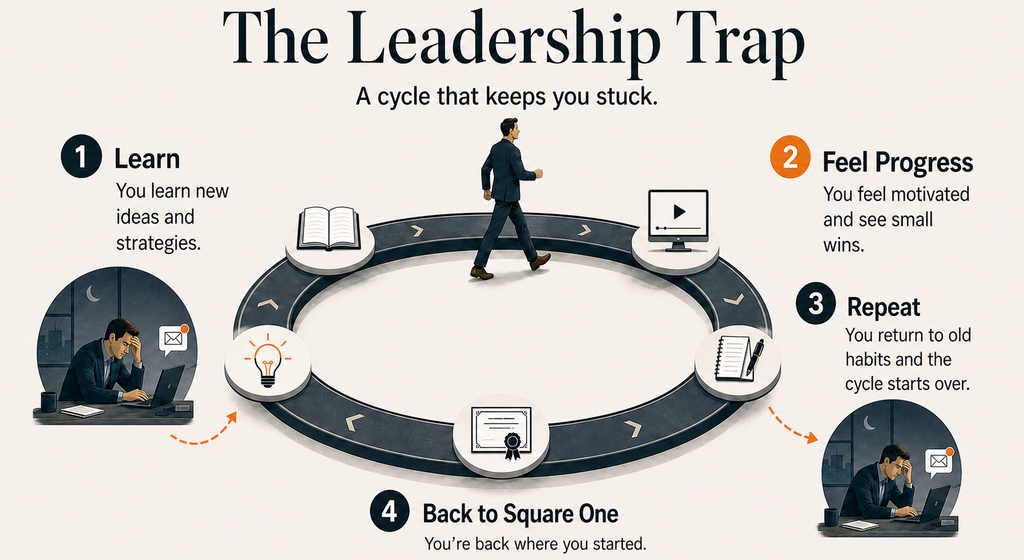
The trap isn’t laziness. It’s that acquiring knowledge produces a real feeling of progress, and that feeling quietly stands in for the harder work of changing the way you actually lead under pressure. You’ve moved. You just haven’t moved anywhere.
Can I ask you something honest? How many frameworks do you already own that would fix your calendar if you used them?
Why Isn’t Knowing “How” Enough to Change How You Lead?
Because intention is a weaker predictor of behaviour than most people assume.
Paschal Sheeran and Thomas Webb’s synthesis of the intention-behaviour literature found that producing a medium-to-large shift in someone’s intentions generated only a small-to-medium shift in what they actually did. They also identified who drives the gap: not people who never meant to change, but people who fully intended to and then didn’t. Inclined abstainers.
Sit with that phrase. The gap isn’t populated by the uncommitted. It’s populated by people exactly like you who meant it, who still mean it, and who keep not doing it.
So the honest interpretation is narrower than the usual coaching claim. Intention isn’t useless. It’s just not sufficient on its own, particularly when the behaviour has to happen mid-week, under pressure, in the same environment where you’ve always done the opposite.
What Is the Knowing-Doing Gap in Leadership?
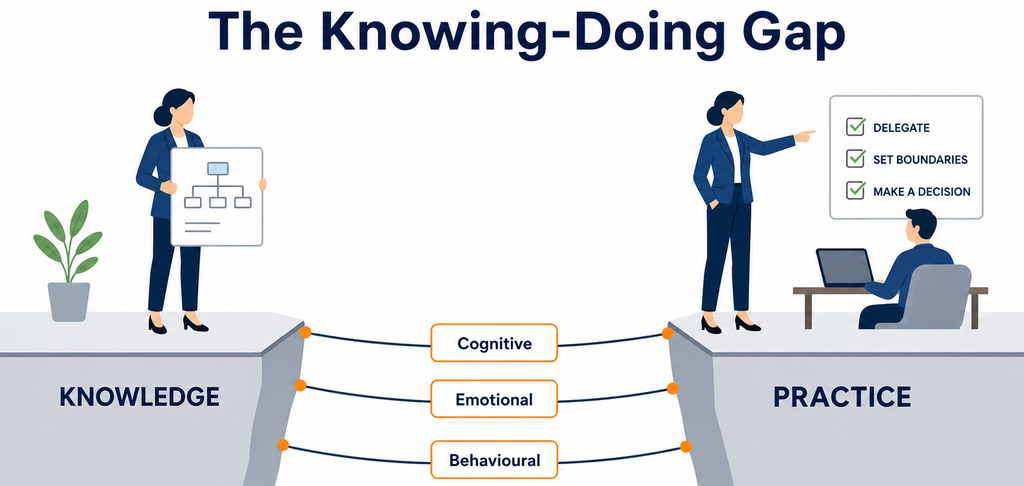
It’s the documented discrepancy between what a leader understands about leadership and what they transfer into practice.
The clearest work on this is Amal Ahmadi and Bettina Vogel’s study in the Academy of Management Learning & Education, analysing 65 critical incidents from interviews with UK managers. They describe the gap as multifaceted cognitive, emotional and behavioural at once- not a simple failure to remember the training.
That emotional dimension matters more than it sounds. The gap isn’t only about what you know in the moment. It’s about what you feel in the moment, and what you do to make that feeling stop.
It’s also hard to recognise from inside the behaviour, especially once the behaviour is familiar. You don’t experience it as avoidance. You experience it as being reasonable: this client is different, this week is unusual, deciding fast when the stakes are high can wait until things calm down. They don’t calm down.
Why This Gap Is Especially Uncomfortable for Coaches and Consultants
Because your professional competence is knowing things.
You can name someone else’s pattern with real precision. A client tells you they can’t step back from the business and you see the shape of it in four minutes, and you’re usually right.
Then you close the laptop and repeat your own version of it that same evening.
I want to be careful not to overstate this; I don’t have research showing this audience has a larger gap than anyone else. What I’d say after a decade of working with coaches, consultants and wellness practitioners is that the gap is harder to see here, because fluency looks so much like progress. When you can explain the problem beautifully, explaining starts to feel like solving.
When Strategy Isn’t the Problem: What’s Actually Running the Behaviour?
Often, something automatic is.
Habit research offers the most useful lens. Work by David Neal, Wendy Wood and Jeffrey Quinn on how habits are triggered found that when a response has been performed frequently in a stable context, people tend to repeat it regardless of intention and that intentions predict behaviour less well as habit strength increases.
Read that as practical rather than mechanical. Strong habits don’t overpower you like a force. They make your behaviour less responsive to what you consciously decided, particularly when the same cues keep showing up. Same desk. Same inbox. Same hour of the evening. Same feeling in your chest when a client sounds disappointed.
Which reframes the work. You may not need more motivation. You may need to change the cue, the routine, or the environment producing the response part of why change takes longer than it should.
A definition, because this phrase gets thrown around loosely. When I say unconscious programming, I don’t mean a hidden force running your decisions. I mean the learned patterns habits, assumptions, emotional associations, automatic responses that shape what you do before deliberate reasoning gets a look in. That’s a coaching frame, not a neuroscience finding.
The Four Patterns That Survive Every Course
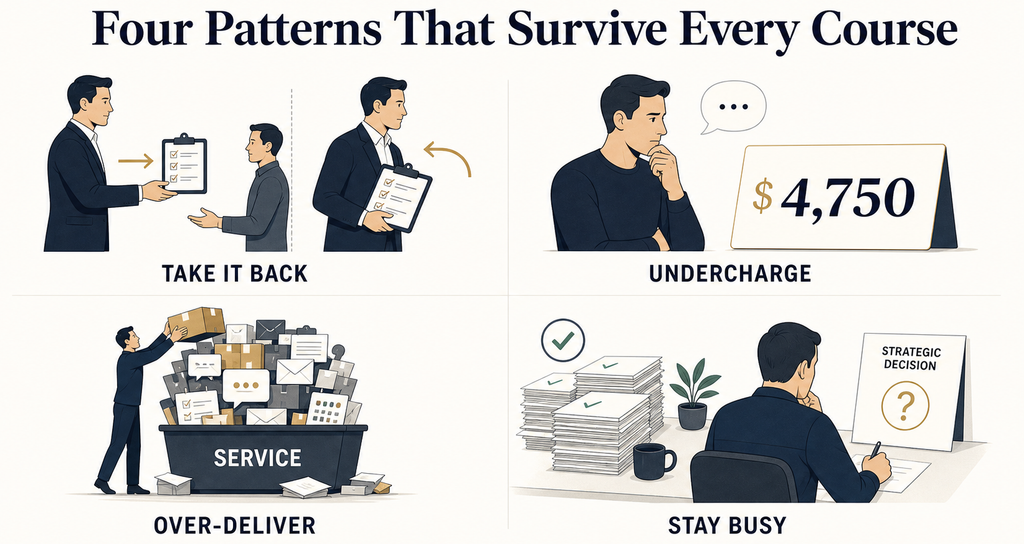
These four come up most, and they’re concrete for a reason. Nobody has ever been freed by the phrase “limiting beliefs.”
- You can’t delegate without taking it back. You hand it over, then rewrite it at 10 pm because it wasn’t quite right.
- You undercharge. You’ve known your rates are low for two years. The number still comes out apologetically.
- You over-deliver past the point of profitability. Disappointing someone feels unbearable, so you add another call, another resource, another hour.
- You stay busy instead of making the bold move. The admin gets done. The one thing that would change the business is postponed behind fear wearing a convincing costume.
To work on these properly, it helps to identify the beliefs actually running the decision rather than argue with the behaviour.
Here’s how I’ve come to see it after a decade my interpretation, not a research finding: your unconscious is quietly protecting you from the one move that would change everything. Not because it’s broken. Because that move carries risk, and the current pattern has kept you safe so far.
Does More Training Close the Gap?
Sometimes. Often not and it depends entirely on what the actual bottleneck is.
Training delivers knowledge and skill, and that’s real. But when the bottleneck is implementation rather than information, more information doesn’t address what’s stuck. The Center for Creative Leadership’s work on the leadership gap makes a related point: the obstacles that persist tend to be behavioural rather than technical.
Gallup’s research is worth sitting with here. Studying 143 Inc. 500 CEOs, Gallup found those with high delegator talent posted substantially stronger three-year growth, and that strong delegator talent is uncommon among employer entrepreneurs generally.
That doesn’t establish why delegation is hard. It can’t. What it does is unsettle a comfortable assumption that knowing delegation technique makes delegating easy. For most founders, clearly it doesn’t.
Here’s my own version. I spent 14 years in corporate at IBM, Lenovo and Novell, then built eight businesses. By the fifth, I was working 80-hour weeks, on anxiety medication, calling it success. I could have taught a competent workshop on delegation that entire year. I knew every principle. I delegated almost nothing. What ended it wasn’t new information; it was my niece asking why I don’t visit anymore.
How Do You Actually Close the Gap?
By working on the pattern first, then the strategy, then the structure in that order.
Let me be precise about what I’m claiming. The research above doesn’t test my method; nothing here proves the 5 Shifts to Freedom work. What it does is point toward mechanisms: intention is insufficient, context cues drive repetition, planning the specific moment helps and those mechanisms inform how I’ve built the work.
The 5 Shifts to Freedom is the only method that rewires the unconscious programming keeping you overworked, then rebuilds your strategy and your business around your life. Because strategy without psychology is just another unfinished course and mindset without systems is a prettier prison. The mechanism underneath is the 3 Pillars: Performance Psychology, Freedom-First Business Strategy, Freedom-First Business Structure. You need all three.
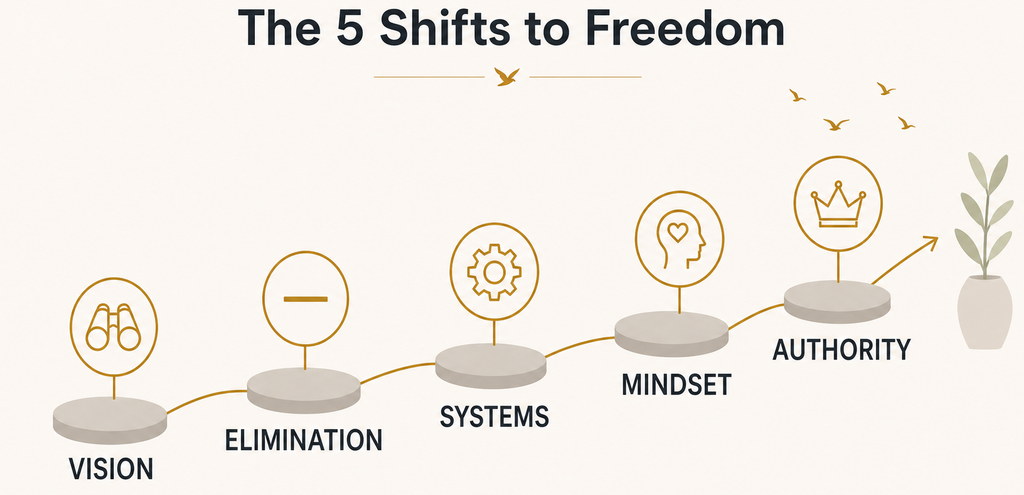
Step 1: Vision Alignment: Get clear on what you actually want, not what you think you should want. Most stuck people execute brilliantly against someone else’s definition.
Step 2: Ruthless Elimination: Cut the 80% of activity consuming your time and energy so the 20% has room to produce.
Step 3: Systems That Scale: Get the expertise out of your head and into something that runs without you standing next to it.
Step 4: Mindset Unlock: Change the response patterns pulling you back to the behaviour you’ve outgrown. This is the shift that makes the other four survive a difficult Tuesday.
Step 5: Magnetic Authority: Position yourself so the right clients recognise you immediately, and charge accordingly.
One tool worth borrowing whether or not you ever work with me. Peter Gollwitzer and Paschal Sheeran’s meta-analysis of 94 independent tests found that if-then plans specifying when, where and how you’ll act produced a medium-to-large effect on goal attainment. Not “I’ll delegate more.” Rather: “If a client emails after 6 pm, then it goes in the morning queue, and my assistant drafts the reply.”
Jennifer (name changed) had an extraordinary background and rates that badly undersold it. She knew she should raise them, had known for a long time, and could argue the case more persuasively than I could. Deep reconditioning work, not affirmations and within 60 days she’d doubled her prices and more than doubled her revenue. Same expertise, same market, different self-concept. Doubled her prices in 60 days. The strategy was never her problem. Her programming was.
When the Gap Isn’t Psychological
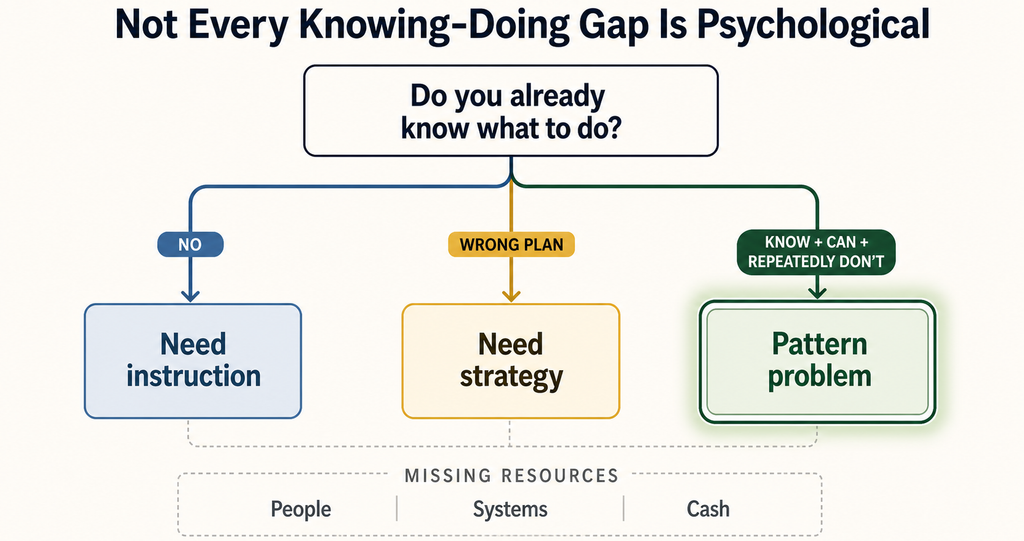
Not every knowing-doing gap is a pattern problem, and pretending otherwise would be dishonest.
Sometimes you genuinely don’t know how, and you need instruction. Sometimes the strategy is wrong, and no amount of psychological work will make a bad plan produce results. Sometimes the business lacks the people, systems or cash the behaviour requires you can’t delegate to a team you haven’t hired.
Psychology-first earns its place in one situation: you already understand the required action, you have the means to take it, and you repeatedly don’t. Everything else is a different problem wearing similar clothes.
Who Should Use This Approach?
- Coaches, consultants and wellness practitioners working 50–60+ hours with results that prove they can build something
- Owners who’ve been naming their own bottleneck precisely for over a year
- People who bought the courses, understood them, and changed very little
- Anyone whose business has quietly become the thing they resent
Who Should Avoid It?
- Anyone genuinely early without proof of concept you need customers, not pattern work
- Anyone wanting a pure tactics playbook and no examination of their own behaviour
- Anyone whose real constraint is wrong strategy or missing resources, not repetition
- Anyone hoping for a health outcome. My own recovery is mine to tell; a business programme doesn’t promise it
Knowledge-First vs. Psychology-First Development
Both have a place. The mistake is applying the wrong one to your bottleneck.
| Particulars | Knowledge-First | Psychology-First |
|---|---|---|
| Core assumption | You need better information | You need a different response pattern |
| Fixes well | Genuine skill gaps, new domains, technical work | Repetition despite understanding |
| Misses | Behaviour that persists after learning | Real skill and resource shortfalls |
| Typical format | Courses, books, frameworks, certifications | Reconditioning work, structured support, environmental change |
| Feels like | Immediate progress | Slow, then sudden |
| Ideal user | Someone who honestly doesn’t know how | Someone who knows exactly how and doesn’t do it |
Data & Findings
Each finding below is stated with what it does and doesn’t establish.
1. Intentions predict behaviour weakly. Sheeran and Webb found medium-to-large intention shifts produced only small-to-medium behaviour shifts, with “inclined abstainers” driving most of the gap. Doesn’t establish why any individual fails to act.
2. The leadership gap is emotional, not just cognitive. Ahmadi and Vogel’s analysis of 65 critical incidents describes cognitive, affective and behavioural elements interacting. Doesn’t establish prevalence across all leaders.
3. Habit strength reduces intention’s predictive power. Neal, Wood and Quinn found strongly habitual behaviour repeated regardless of stated intentions. Doesn’t establish: that all stuck behaviour is habitual.
4. Much of daily behaviour is context-linked repetition. In one diary study, roughly 43% of participants’ daily behaviours were performed frequently and in the same setting, consistent with habitual responding. The number isn’t the point. The context-dependence is.
5. If-then planning has a solid evidence base. Across 94 independent tests, implementation intentions produced a medium-to-large effect on goal attainment. Doesn’t establish that it resolves emotionally loaded avoidance alone.
6. The wider context is strain. A 2026 survey of 1,000 small business owners and managers found only 22.5% described their mental health as thriving.
David (name changed) was brilliant at the work and completely trapped by it; everything ran through him, and he knew it. Thirty days getting his expertise onto paper, his assistant taking over most of his inbox, and he took his first real two-week holiday in five years. Revenue went up while he was gone. First two-week holiday in five years, and the business grew without him. That’s what happens when your expertise stops living in your head.
Frequently Asked Questions
What is the leadership knowing-doing gap?
It’s the documented discrepancy between what a leader understands about leadership and what they actually do in practice. Research in the Academy of Management Learning & Education describes it as cognitive, emotional and behavioural at once, rather than a simple failure to recall training.
Why can’t I delegate even though I know exactly how?
Because delegation is rarely blocked by missing technique. When a response has been repeated often in the same context, you fix it yourself, late, because it’s faster; that response becomes less sensitive to what you intended. The useful question is what happens in the seconds before you take the work back.
Does leadership training actually work?
Training reliably delivers knowledge and skill. Where it struggles is when the bottleneck is implementation rather than information. If you already understand the required action and still don’t take it, more content is unlikely to be the missing piece.
How long does it take to change a pattern like this?
It varies, and anyone giving you a fixed number is guessing. What’s consistent is that structured support and environmental change tend to matter more than duration. The 16-week programme I run exists because meaningful change needs implementation time, not a weekend.
Is this the same as mindset work?
Not quite. Mindset work on its own tends to feel good and change little. What I’m describing pairs pattern-level work with strategy and structure because a new self-concept without a redesigned business just makes the same week slightly more pleasant.
Conclusion
You are not undisciplined. You’re a capable person running a pattern that made sense at some point and has now outlived its usefulness.
That’s a better problem than a knowledge problem, because it’s specific and workable. The map was never missing. The walking is.
Yesterday I trained in the morning, worked about five hours, took a 36-minute nap without a shred of guilt, and had dinner with my phone in another room. That isn’t a flex. It’s evidence that what you’re being sold as the reward for scaling is available considerably earlier than anyone told you.
The Freedom Blueprint Call: 45 minutes. We’ll find the one thing that’s actually keeping you stuck. No pitch unless you ask for one.