

Limiting beliefs are unexamined assumptions about money, worth, or capability that quietly shape earning-related decisions, from what you charge to whether you ask for a raise. They don’t cap your income directly. Instead, they influence behavior, and behavior produces results. Someone who believes “I’m not qualified enough yet” tends to underprice, hesitate, or avoid visibility, which in turn limits opportunity.
Skills, market demand, experience, and business fundamentals still matter enormously. Reframing a belief doesn’t replace the work of building real value, but it removes the invisible brakes that keep capable people from acting on the opportunities already in front of them. This guide covers the seven beliefs that show up most often in coaching conversations, along with a practical reframe and one action for each.
Key Takeaway:
- Limiting beliefs about money, success, and self-worth can quietly influence financial decisions by causing underpricing, procrastination, fear of selling, or avoiding growth opportunities. Recognizing these subconscious patterns is the first step toward increasing your earning potential. [1]
- Common income-limiting beliefs include thoughts such as “I’m not good enough,” “People won’t pay that much,” or “Success requires constant struggle.” NLP techniques like reframing, visualization, and language awareness can help challenge these beliefs and replace them with more empowering perspectives. [1]
- Mindset alone doesn’t increase income. Lasting financial growth comes from combining healthier beliefs with practical actions such as improving your skills, confidently communicating your value, setting appropriate prices, and consistently taking strategic business actions. [2]
- Changing deeply rooted beliefs takes time and repetition. Regular self-reflection, coaching, ongoing practice, and accountability can help reinforce new thinking patterns that support long-term confidence, better decision-making, and sustainable financial growth. [2]
Bottom Line: Limiting beliefs don’t directly determine your income, but they can influence the choices and behaviors that shape your financial results. By identifying unhelpful thought patterns and pairing mindset work with consistent action, you can build greater confidence, create more opportunities, and unlock your true earning potential.
Can Limiting Beliefs Really Affect Your Income?
Beliefs shape behavior long before they show up in a bank statement. Someone convinced that “money is hard to earn” tends to work longer hours for less return, because the belief itself discourages simpler paths. Someone who fears rejection avoids negotiating a rate, so the rate stays flat for years.
The pattern usually looks like this: a belief triggers a specific behavior, and that behavior produces a result that seems to confirm the original belief. Common examples include underpricing services, avoiding negotiation altogether, staying invisible instead of marketing openly, delaying a launch until conditions feel “perfect,” and turning down opportunities that don’t match an old self-image.
It’s worth saying clearly: beliefs are one factor among several. Market demand, industry conditions, skill level, and experience all play a real role in earning potential. Mindset work supports better decisions. It doesn’t replace the fundamentals.
Common Signs You May Have an Income-Limiting Belief
A few patterns tend to repeat across clients who later discover a belief was quietly running the show:
- Constantly undercharging compared to peers with similar experience
- Avoiding conversations about raises, contracts, or renegotiation
- Feeling guilty or uncomfortable when income increases
- Assuming success or wealth belongs to “other kinds of people”
- Anticipating criticism or judgment the moment things go well
- Never feeling qualified enough, no matter how much training is completed
- Waiting for the “right moment” that never quite arrives
If two or three of these sound familiar, there’s likely a belief worth examining underneath them. The first real step is learning how to identify your own limiting beliefs before trying to change anything.
Why Limiting Beliefs Become Self-Sabotaging
Limiting beliefs are sticky because of how the mind naturally operates, not because of some personal flaw. A few mechanisms are worth understanding:
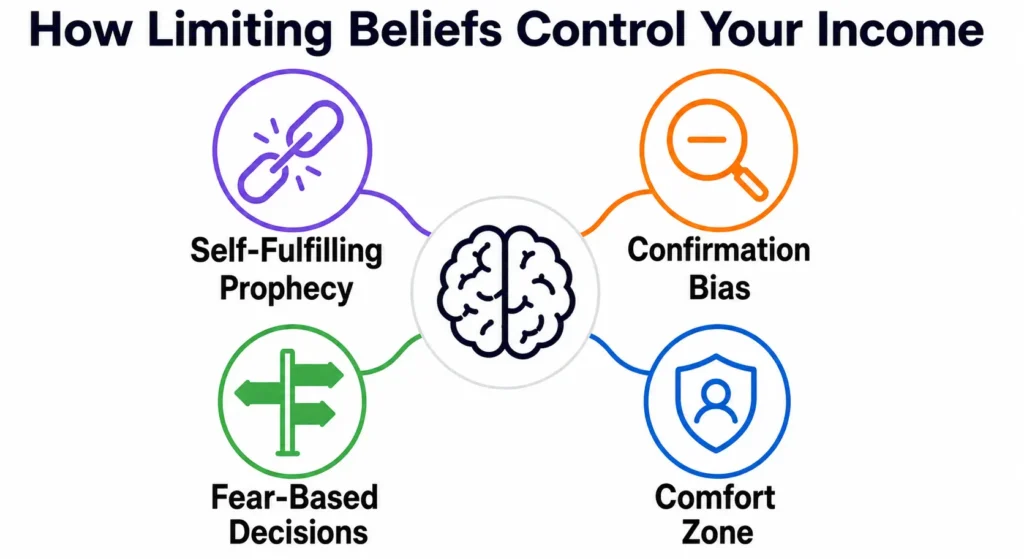
- Self-fulfilling prophecy. Expecting failure, rejection, or scarcity changes behavior enough to help produce exactly that outcome.
- Confirmation bias. Once a belief is in place, the mind naturally notices evidence that supports it and quietly discounts evidence that doesn’t.
- Fear-based decision making. Beliefs rooted in fear push people toward the safest, smallest option available, even when a bigger opportunity is objectively better.
- Comfort zones and habit loops. Familiar income levels and familiar routines feel safer than an unfamiliar (even better) outcome, so people unconsciously steer back toward what they already know.
Many coaching approaches, including NLP-inspired reframing techniques, work by helping people slow down enough to notice these patterns and question them directly rather than acting on autopilot. This is the same territory covered in overcoming limiting beliefs with NLP, which goes deeper into the specific techniques coaches use.
The 7 Limiting Beliefs Sabotaging Your Income
Belief #1: “Money Is Hard to Earn”
- How it shows up: Long hours, thin margins, and a nagging sense that ease equals laziness.
- Why it limits income: This belief usually traces back to childhood money messages, things overheard at the dinner table or absorbed from a household where money felt scarce. Once internalized, it pushes people toward working harder rather than working smarter, even when a simpler, higher-value path is available.
- The reframe: Income can come from the value created, not only the hours logged. A well-positioned offer, a repeatable system, or a single strong client relationship can outperform months of undervalued effort.
- One action today: Write down one piece of evidence, past or present, that income has come to you through value rather than pure hours. This is Step B (Become Aware) of the B.R.E.A.K. framework in action.
Belief #2: “I’m Not Qualified Enough Yet”
- How it shows up: Endless certifications, delayed launches, and a running list of “just one more thing to learn first.”
- Why it limits income: This is the classic pattern behind imposter syndrome: a persistent feeling of not measuring up, regardless of actual results. It often leads to chronic underpricing, since people undervalue expertise they don’t fully believe they have earned.
- The reframe: Qualification is demonstrated through outcomes delivered, not credentials collected. Clients and employers pay for results, not for a perfect resume.
- One action today: List three concrete achievements or client outcomes instead of the perceived gaps. This is Step R (Review the Evidence) of the framework.
Belief #3: “If I Charge More, People Will Leave”
- How it shows up: Rates that haven’t moved in years, apologetic pricing conversations, and quiet resentment toward underpaying clients.
- Why it limits income: This is a catastrophic prediction: assuming every client will vanish the moment a price changes. In practice, clients who leave over a reasonable increase were often not the right fit at any price.
- The reframe: A price increase tests the market. It doesn’t guarantee abandonment, and the data from an actual test is far more useful than an assumption.
- One action today: Choose one upcoming proposal or renewal and test a modest increase, then track what actually happens rather than what fear predicts. This reflects Step A (Act Differently).
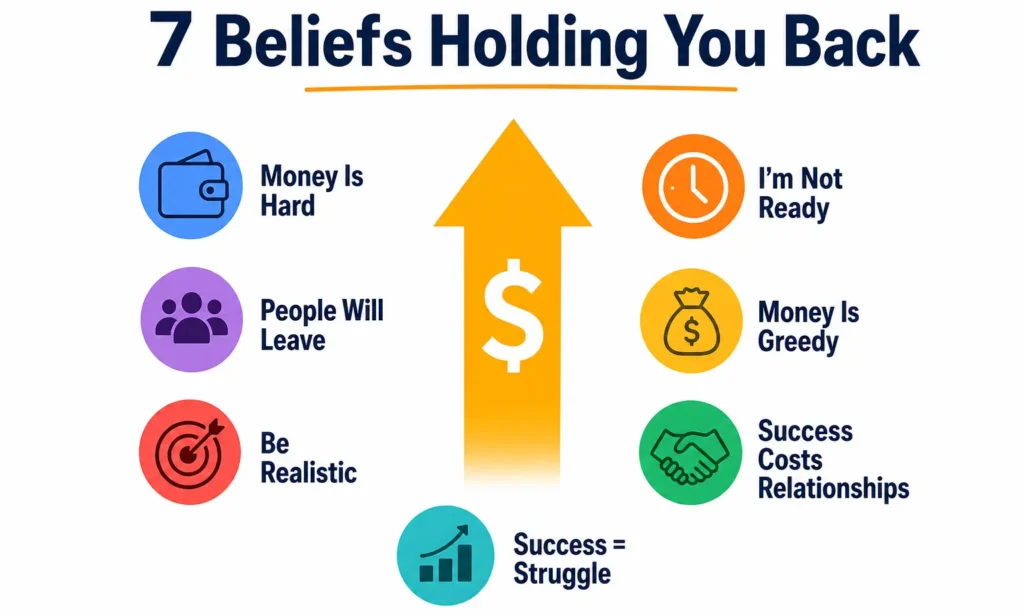
Belief #4: “Wanting More Money Makes Me Greedy”
- How it shows up: Discomfort discussing income, discounting work “to be fair,” and quietly sabotaging growth to avoid feeling selfish.
- Why it limits income: Cultural and family narratives around money often carry guilt or moral judgment. Left unexamined, that guilt shows up as self-imposed income ceilings.
- The reframe: Additional income is simply a resource. What it enables (security, family stability, growth, greater impact) is the more accurate lens than a vague label like “greedy.”
- One action today: Write down three specific things more income would allow, beyond the number itself.
Belief #5: “I Have to Be Realistic”
- How it shows up: Goals capped low “just in case,” ambitions quietly downsized, and a habit of playing smaller than actual capability.
- Why it limits income: The word “realistic” often functions as a ceiling in disguise, set by experience rather than present capacity.
- The reframe: Realistic and small are not the same thing. A goal can be ambitious and still be grounded in a concrete plan.
Mini Case Study: Darren G. Darren came to coaching feeling stuck despite holding a well-paying job. He described feeling hopeless and purposeless, blocked from promotions, raises, and the idea of ever starting his own business, even though nothing about his skills or work ethic explained the block. Working through what James calls “goal blocks,” a set of limiting beliefs most people carry without realizing it, Darren began identifying the specific assumptions that had quietly capped his ambition for years. Naming those beliefs directly, then challenging their accuracy, created a shift in how he approached decisions at work and in his personal goals. The result was a broader change in mindset and behavior that extended beyond his income, improving his relationships along the way.
One action today: Write down the goal you’d set if “realistic” wasn’t part of the sentence. Building this kind of entrepreneurial mindset is often what separates a capped goal from one that actually gets pursued.
Belief #6: “Success Only Comes Through Struggle”
- How it shows up: Burnout, an inability to delegate, and a quiet suspicion that anything achieved with relative ease “doesn’t count.”
- Why it limits income: Hustle culture rewards visible effort over actual results, which can trap capable people in unnecessary difficulty long after a simpler system would work better.
- The reframe: Struggle isn’t proof of value. A system, a delegated task, or a more efficient process can produce the same or better result with far less friction.
- One action today: Identify one recurring task that could be simplified, automated, or handed off this month.
Belief #7: “If I Become Successful, I’ll Lose People”
- How it shows up: Self-sabotage right before a breakthrough, discomfort with visibility, and quietly downplaying wins around certain people.
- Why it limits income: Growth can genuinely shift relationships, and the fear of that shift, rooted in identity and belonging, is real. Left unexamined, it can lead someone to hold back rather than risk outgrowing their current circle.
- The reframe: Relationships built on genuine connection tend to adapt to growth. Relationships that can’t tolerate any change were often more fragile than they appeared.
- One action today: Identify one relationship that has consistently supported your growth versus one shaped mostly by comfort or fear of change.
Scarcity Thinking vs Growth-Oriented Thinking
| Scarcity Thinking | Growth-Oriented Thinking |
| Avoids risk entirely | Takes calculated, informed risks |
| Competes from fear | Creates value and expands the pie |
| Underprices out of anxiety | Prices according to actual value delivered |
| Waits for permission | Takes initiative |
| Focuses on limitations | Focuses on available opportunities |
| Avoids negotiation | Negotiates directly and professionally |
Data & Findings
Research on imposter syndrome offers some of the clearest evidence connecting mindset to earning behavior. A widely cited entrepreneurship survey found that the large majority of entrepreneurs and small business owners report experiencing impostor phenomenon at some point, with similarly high rates reported among corporate leaders in separate research. That same body of research links imposter feelings directly to pricing behavior: business owners describe chronically undercharging clients as a way to seek external validation, which, in turn, creates a cycle in which more clients are taken on at lower rates just to hit the same income target.
Separate coverage of entrepreneurial mindset work points to the origin of many money beliefs in childhood conditioning and family financial culture, which helps explain why these patterns tend to be unconscious rather than deliberate. On the pricing side, reporting on founders and pricing psychology consistently identifies fear of failure and low self-confidence as the two most common drivers of self-sabotaging financial decisions.
None of this suggests mindset is the only variable. It simply confirms what many coaches observe firsthand: the psychological layer is measurable, common, and worth addressing directly, alongside the practical keys to increasing your income.
The B.R.E.A.K. Framework
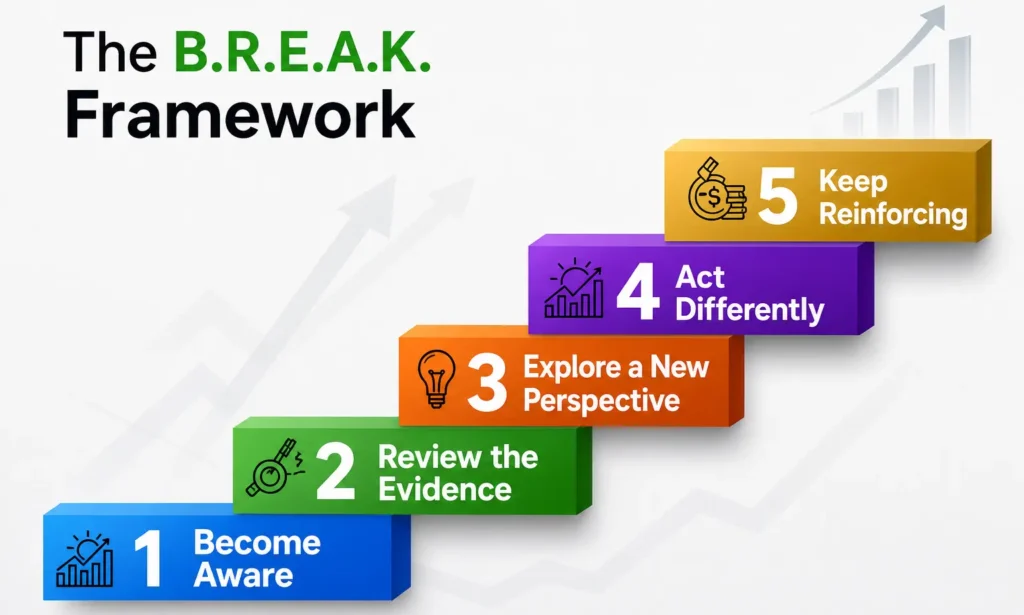
James’s practical coaching framework, inspired by reframing techniques commonly used in NLP and cognitive coaching, gives readers a repeatable process for working through any income-limiting belief.
Become Aware:
Name the specific belief and notice where it shows up in daily decisions, whether that’s a pricing conversation, a hesitation to apply for something, or a familiar internal script.
Review the Evidence:
Ask whether facts actually support the belief, or whether it’s simply an old assumption that has never been tested.
Explore a New Perspective:
Replace the rigid, all-or-nothing version of the belief with a more balanced, workable interpretation.
Act Differently:
Choose one specific behavior that aligns with the new perspective, even if it feels unfamiliar at first.
Keep Reinforcing:
Repeat the process consistently. A single reframe rarely sticks after one attempt. It becomes durable through repetition.
Each belief above ties back to one or more steps of this process, and the framework works equally well applied to any limiting belief beyond the seven covered here. For a deeper look at breaking specific patterns, see how to overcome mindset blocks.
How to Make New Money Beliefs Stick
Recognizing a limiting belief is only the beginning. The real challenge is consistently acting from a new perspective until it becomes your default way of thinking. Lasting change happens through repetition, not a single breakthrough.
One effective approach is to notice situations that trigger your old beliefs, such as quoting your prices, asking for a raise, or making an investment in your business. Before reacting, pause and ask yourself, “Am I responding to today’s reality or to an old story I’ve been telling myself?” That simple question creates space to make a more intentional decision.
It also helps to keep a record of small wins. Every successful negotiation, new client, promotion, or positive financial decision provides evidence that challenges outdated beliefs. Over time, these experiences become stronger than the assumptions that once held you back.
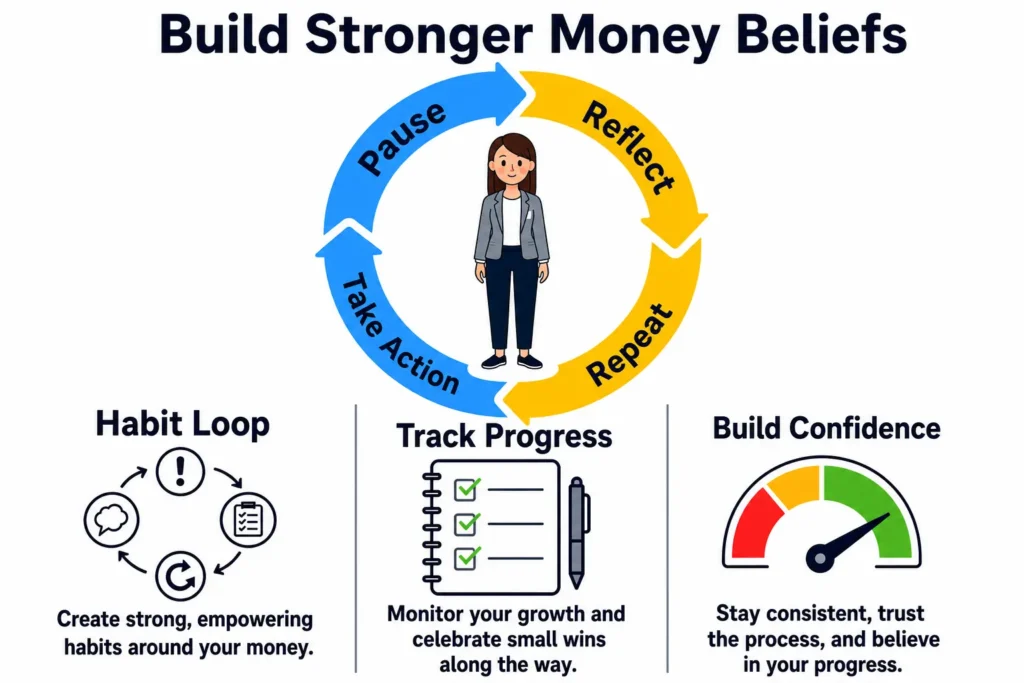
Finally, remember that changing beliefs doesn’t mean ignoring reality. Continue building valuable skills, improving your expertise, and making informed financial decisions. A healthier mindset works best when it’s paired with consistent action. As your confidence grows through real-world results, your new beliefs become increasingly natural, making it easier to pursue opportunities that once felt out of reach.
Who Benefits Most from Reframing Income Beliefs?
This kind of work tends to help:
- Professionals seeking a promotion or raise they’ve been putting off
- Entrepreneurs building or scaling a business
- Freelancers and consultants setting or renegotiating rates
- Coaches and service providers pricing their offers
- Business owners feeling capped despite steady demand
- Career changers stepping into unfamiliar territory
When Mindset Work Isn’t the First Priority
Reframing beliefs is genuinely useful, but it isn’t a substitute for addressing urgent practical needs. If someone is facing acute financial hardship, lacks a marketable skill entirely, has a business model that doesn’t work regardless of mindset, or is dealing with an immediate cash flow crisis, those issues deserve direct attention first. Mindset work is most effective alongside solid fundamentals, not instead of them.
Frequently Asked Questions
What are limiting beliefs about money?
They are unexamined assumptions about earning, worth, or capability that shape financial decisions, often formed in childhood or through experience, without being consciously questioned.
Can changing my mindset really increase my income?
Mindset shifts change behavior, such as pricing, negotiation, and visibility, which can open the door to better outcomes. Income still depends on skills, market demand, and consistent action.
How long does it take to change limiting beliefs?
It varies by person and belief, but most coaching approaches emphasize repetition over time rather than a single insight. Consistent practice tends to matter more than the speed of the initial shift.
What is the difference between scarcity and growth-oriented thinking?
Scarcity thinking focuses on risk avoidance and limitation. Growth-oriented thinking focuses on value creation and available opportunity, even under the same external conditions.
Is NLP scientifically proven?
NLP has limited formal research validation, though many practitioners and clients report meaningful, practical results from its reframing and communication techniques. It’s best approached as a practical coaching tool rather than a clinically validated therapy.
Do I need a coach to overcome limiting beliefs?
Not necessarily. Self-directed reflection using a framework like B.R.E.A.K. can help. Many people find that outside perspective speeds up the process, since blind spots are, by definition, hard to see alone.
Conclusion
Every professional carries a set of beliefs shaped by childhood, experience, and the people around them. Some of those beliefs genuinely help. Others quietly cap what feels possible, long before ability or opportunity ever enter the picture. The goal isn’t blind optimism or pretending every fear is unfounded. It’s building a more accurate, more useful way of thinking, one that reflects present capability rather than an old story. Small shifts in perspective, tested through real action, tend to compound over time into meaningfully different decisions and outcomes.
If you’ve recognized several of these limiting beliefs in yourself, personalized coaching can help you uncover the patterns influencing your decisions and build practical strategies for lasting change. James’s core coaching program combines proven coaching techniques with real-world business insight to help professionals and entrepreneurs build confidence, make better decisions, and pursue greater earning potential. Unleash Your Power: Stand Out, Take Action, and Create the Success You Want.