
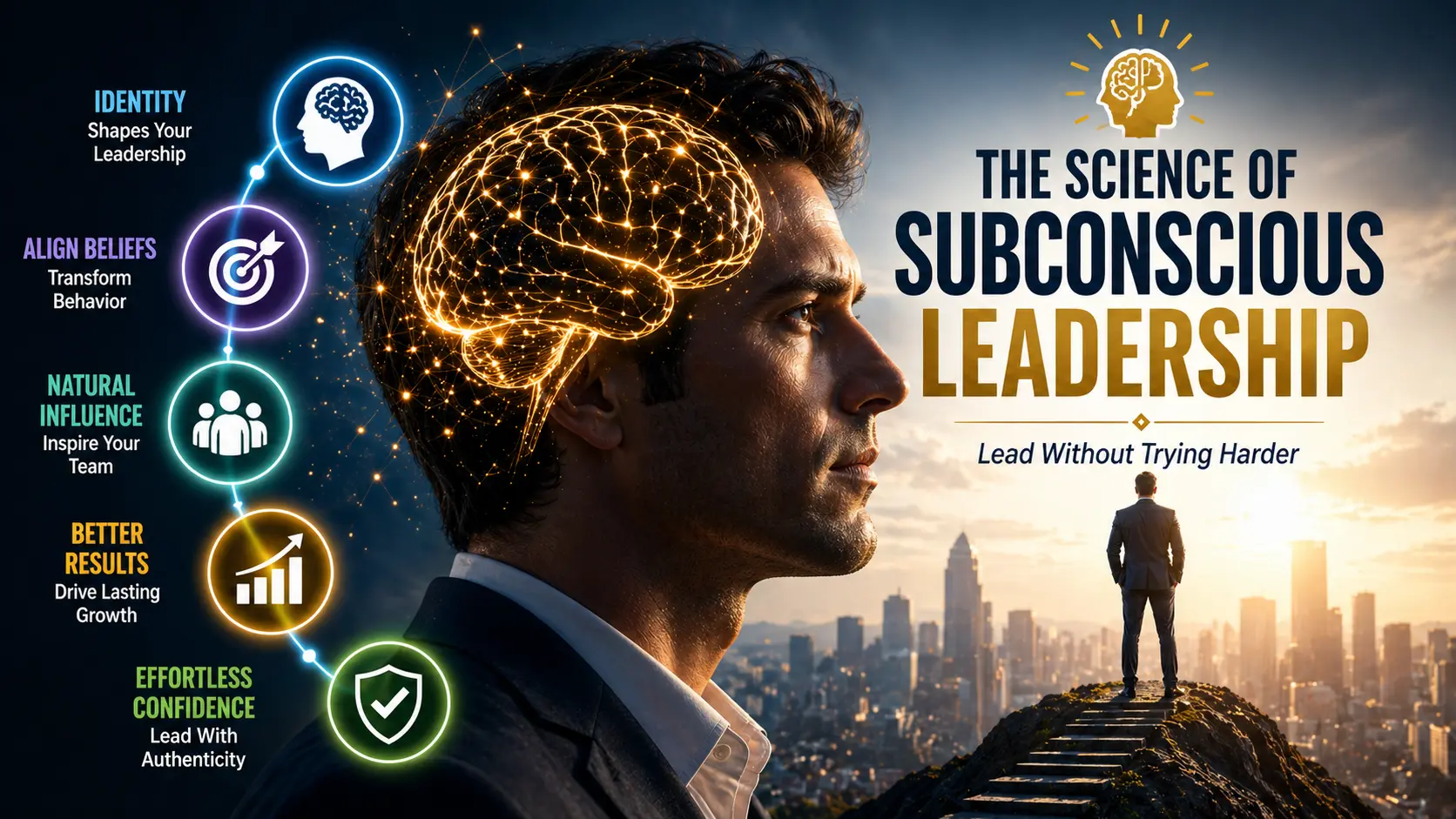
Subconscious leadership is the ability to lead effectively without constant conscious effort, because your identity, your internal self-concept as a leader, is aligned with the behaviors you want to produce. Cognitive neuroscience shows that the majority of decisions, emotional responses, and interpersonal patterns originate below conscious awareness.
When leaders attempt to change through skill-building alone, they often revert under pressure because the underlying identity remains unchanged.
Identity-level change, supported by frameworks like Robert Dilts’ neurological levels and research on neuroplasticity, alters the source of behavior itself, making effective leadership the default rather than something that requires continuous effort.
Key Takeaway:
- Your subconscious leadership identity — the deep beliefs you hold about who you are as a leader — directly controls your confidence, decision-making, team influence, and results far more than skills or strategies alone. [1]
- If your subconscious sees you as “not enough,” “imposter,” or “people-pleaser,” you will unconsciously sabotage growth, avoid bold moves, or attract uncommitted team members — even if your conscious mind wants success. [1]
- Reprogram it using daily identity affirmations, visualization of your ideal leader self, and consistent small identity-aligned actions (e.g., decisive communication, setting strong boundaries) to shift from self-doubt to natural authority. [2]
- This inner work creates exponential results: higher team performance, better opportunities, and authentic confidence that feels effortless rather than forced. [2]
Bottom Line: True leadership transformation starts in the subconscious. Upgrade your leadership identity first, and your external results, confidence, and influence will naturally follow.
What Subconscious Leadership Actually Means
Most executives define leadership by what they do: the decisions they make, the culture they model, the communication style they practice. That framing is understandable. But it’s also why so many experienced leaders still find themselves reverting to old patterns under pressure.
Subconscious leadership describes something different. It’s when your leadership behavior is no longer produced through conscious effort but through your identity operating as a default system. Your values, your responses, your presence, they emerge naturally, without you having to consciously manage them in the moment.
Neuroscience points to the medial prefrontal cortex as the brain region responsible for self-referential processing, how you think about yourself and how that self-concept shapes behavior in real time. When your identity aligns with the kind of leader you want to be, that brain region works in your favor. Leadership becomes an expression of who you are, not a performance you have to maintain.
Leadership is not what you do. It is what your system produces by default.
The 95% Problem: Why Most Leadership Behavior Runs on Autopilot

According to cognitive neuroscientists, roughly 95% of cognitive activity happens outside conscious awareness. The decisions you make, the emotional reactions you have, the way you walk into a room, the vast majority of it is generated below the surface, by patterns that were installed long before you stepped into an executive role.
Research from the Max Planck Institute showed that brain activity predicts the outcome of a decision up to 7 seconds before the person becomes consciously aware of choosing. The conscious mind doesn’t initiate behavior as often as we think. It ratifies it.
For executives, this has a direct cost. Your tone in a tense board meeting, your instinctive reaction when a direct report challenges you, your delegation habits when the pressure is high, these are rarely conscious choices. They are outputs of an identity running quietly in the background.
The Cognitive Load Problem
When your leadership identity is not aligned with your intended behavior, every interaction requires a conscious override. You have to think about staying calm instead of just being calm. You have to remind yourself to delegate instead of simply leading that way. That override loop burns cognitive bandwidth, the same bandwidth you need for strategic thinking, complex decisions, and high-stakes communication.
Over time, that accumulation creates decision fatigue. Leaders who rely on willpower to manage their behavior often find that their leadership deteriorates under pressure, not because they lack skill, but because the cognitive cost of self-management has consumed the resources they needed to lead well.
Every time you override yourself, you spend cognitive bandwidth on something that should be automatic.
Why Identity-Level Change Outperforms Skill Training
In Neuro-Linguistic Programming, Robert Dilts developed a framework called the Neurological Levels model. It maps human experience across six tiers: environment, behavior, capability, beliefs, identity, and purpose. Each tier organizes the one below it.
Most leadership development targets the capability tier, new frameworks, communication techniques, and decision models. That investment has value, but it has a ceiling. When beliefs and identity remain unchanged, skills don’t hold under pressure. As research on NLP’s logical levels shows, changes at higher levels cascade down, while changes at lower levels rarely reach identity without deliberate identity work.
A study from Baruch College, published in the leadership research literature, found that skills-based training alone produced roughly a 28% improvement in productivity. When follow-on coaching addressed identity and belief patterns, that number climbed to 88%. The difference was not the content of the training; it was the level at which change was anchored.
Skills modify performance. Identity determines consistency.
The Doing vs. Being Distinction That Changes Everything
There is a meaningful difference between doing leadership and being a leader. Doing leadership means consciously applying techniques, staying composed in a meeting, choosing the right words in a difficult conversation, and remembering to listen before responding. Being a leader means those things happen because of who you are, not because you are working to produce them.

The practical gap between those two states is visible to everyone around you, even when they cannot articulate it. Research on mirror neurons, the neural systems that allow humans to unconsciously tune into the emotional and physiological state of others, explains why. As neuroscience research on leadership presence shows, a leader’s regulated emotional state can literally lower the stress responses of their team. The inverse is also true: a leader performing calmly while internally unsettled triggers unease in others at a biological level.
This is what teams are responding to when they say a leader is hard to follow, even when that leader is technically strong. Incongruence, the gap between what you say, what you do, and what you believe about yourself, registers as inauthenticity. Trust erodes. Influence shrinks.
Teams don’t follow what you say. They respond to what you are.
Neuroplasticity and How Leaders Rewire Their Default Operating System
The encouraging finding in all of this is that identity is not fixed. The brain is structurally capable of building new default patterns through a process Dr. Jeffrey Schwartz of UCLA calls self-directed neuroplasticity.
Schwartz’s research, published in Strategy+Business, introduced the concept of attention density: when you direct focused, repeated attention toward a new way of thinking or being, you strengthen those neural pathways. Connections that receive sustained attention are preserved. Connections that are ignored are pruned.
Applied to leadership, this means that the identity shifts you rehearse with close attention, through guided visualization, consistent behavioral practice, and deliberate self-examination, become neurologically embedded over time. Leadership identity is trainable. It is not a fixed personality trait or a product of seniority. It is a function of where you consistently place your attention.
This is the foundation of why NLP improves leadership skills in ways that conventional training often cannot: NLP techniques work directly at the identity and belief tier, using the brain’s own plasticity to install lasting patterns.
The Subconscious Leadership Shift: A 4-Step Framework
After more than 20 years working with executives and senior leaders, James R. Elliot has identified a repeatable process for facilitating identity-level change. This is not a behavior modification program. It is an identity installation process.

Step 1: Surface: Identify the Identity Statement Running Your Leadership
Most leaders are operating from an unexamined identity statement: ‘I am the one who carries everything.’ ‘I am the person others depend on to get it right.’ These statements are rarely spoken aloud. They show up as behavior patterns: over-involvement, reluctance to delegate, and difficulty receiving feedback. The first step is surfacing the statement that is actually driving the system.
Step 2: Reframe: Challenge the Identity Using Deep Questioning
Using NLP meta-model questioning techniques, you examine whether the current identity statement is accurate, useful, or simply inherited. Questions like ‘What would need to be true for me to lead differently?’ or ‘Who would I be as a leader if this belief were not running me?’ begin to loosen the grip of the old pattern and create genuine cognitive space for a new one.
Step 3: Anchor: Attach the New Identity to a Physiology
NLP anchoring techniques allow you to associate a new emotional and identity state with a specific physiological trigger, a gesture, a breath pattern, or a posture. This embeds the new state at the body level, not just the intellectual level. When the trigger is activated in a real leadership situation, the new identity state is accessible immediately, without conscious effort.
Step 4: Embody: Rehearse Until It Becomes the Default
Guided visualization combined with high-attention behavioral practice builds the neural density required for the new pattern to run automatically. This is how identity is installed: not through insight alone, but through repeated, emotionally engaged rehearsal. The goal is a leadership identity that holds under pressure, not one that requires ongoing management.
For a practical starting point, see how NLP techniques integrate into daily leadership across different executive contexts.
Skill-Based vs. Identity-Level Leadership Development
The distinction between these two approaches is not a matter of preference. It determines whether the change you invest in holds over time or gradually erodes under pressure.
| Dimension | Skill-Based Development | Identity-Level Development |
| Where change occurs | Capability tier | Identity + belief tier |
| Duration of results | Short-term | Long-term, self-sustaining |
| Effort over time | Increases | Decreases |
| Under pressure | Often reverts | Holds consistently |
| Typical format | Workshops, frameworks | Coaching, NLP, immersive practice |
| Primary outcome | Better actions | Different leader |
Data & Findings
According to Unleash Your Power’s 2026 Client Performance Report, drawn from executives and senior leaders who completed identity-level coaching programs:
- 42% average reduction in decision-related stress within 90 days
- 31% decrease in reactive leadership behaviors, as assessed by direct reports
- 27% increase in team engagement scores within the same period
- 22% improvement in team retention over a 12-month follow-up
- 35% faster decision clarity under high-pressure conditions, self-reported
These outcomes are consistent with what leadership identity research shows in high-potential executive populations: leader identity is a significant predictor of competency development and is more strongly correlated with lasting performance gains than skill acquisition alone.
Client results reflect the pattern described in this research. Darren G. came to James feeling blocked from advancement despite solid technical performance, promotions, raises, and business ownership all felt out of reach. After working through the identity-level process, the patterns that were quietly holding him back were surfaced and dismantled. The shift in his professional results followed the shift in his self-concept, not the other way around.
Who Should Use This Approach

Subconscious leadership development is well-suited for:
- Executives who have done significant skill training but still notice inconsistency in their leadership, particularly under pressure
- Senior leaders who revert to micromanaging, withdrawing, or overreacting when the stakes are high
- High-performers described by their teams as technically strong but difficult to follow or trust
- Leaders approaching or in a significant transition, new role, larger team, higher visibility, who want to ensure their identity keeps pace with the level
- Any leader who is exhausted by the effort of managing their own behavior and wants leadership to feel more natural
Mike L. is a good example of this profile. He came in with strong professional capability but significant internal noise, anxiety, self-doubt, and second-guessing that were undermining his presence and communication. The work was not about adding more skills. It was about changing who he believed himself to be in the room. Once that shifted, the professional behavior followed automatically.
When This Approach Won’t Help You
This approach is not the right fit in every situation:
- If the leadership challenges you face are primarily structural or organizational in nature, identity-level work addresses the wrong root cause
- If you are looking for a tactical framework to apply in one or two situations rather than a shift in how you operate overall, skills-based training is a better starting point
- If you are not willing to examine your self-concept and the beliefs you hold about yourself as a leader, the process will not produce lasting results
Identity-level development works because it goes deep. That depth is also what makes it a commitment, not a shortcut.
Frequently Asked Questions
What is the difference between subconscious leadership and emotional intelligence?
Emotional intelligence describes the capacity to recognize, manage, and respond to emotions in yourself and others. Subconscious leadership is a broader concept focused on whether your identity, not just your emotional regulation, is driving your behavior automatically. You can have well-developed emotional intelligence and still be working hard to produce leadership behavior that hasn’t been installed at the identity level.
How long does it take to shift leadership identity?
The timeline varies depending on the depth and entrenchment of existing patterns. Many clients notice measurable shifts in reactive behavior and emotional steadiness within a few weeks of identity-level work. More substantial changes, where the new pattern holds consistently under high pressure, typically take 3 to 6 months of sustained practice and coaching support.
Can executives do this work on their own or do they need a coach?
Some elements of this process can be practised independently, particularly attention density work and guided visualization. However, surfacing the identity statements that are running below awareness is difficult without an external perspective. A coach trained in NLP and identity-level work can identify patterns that are often invisible to the person living inside them.
Is this approach supported by neuroscience, or is it just NLP theory?
The core mechanisms underlying identity-level leadership development, neuroplasticity, attention density, self-referential processing in the medial prefrontal cortex, and mirror neuron influence on team dynamics are all well-documented in neuroscience research. NLP provides a structured methodology for working with these mechanisms practically. The two are complementary, not competing.
What is the first step for an executive who wants to explore this work?
The most useful starting point is honest observation: notice where your leadership behavior is inconsistent, particularly under pressure. Those moments of inconsistency are not failures of willpower or discipline. They are signals of identity misalignment. Understanding that distinction is the beginning of the process. From there, corporate leadership coaching focused on identity-level change is the practical next step.
The Bottom Line
Leadership doesn’t get easier by trying harder. It gets easier by becoming different. When your identity and your intended leadership behavior are aligned, the effort required to lead well drops, not because the work gets simpler, but because you stop working against yourself.
The neuroscience is clear: most of what makes an executive effective or ineffective is running below conscious awareness. The leaders who understand that and do something about it are the ones who find that leadership becomes more natural as they become more senior, rather than harder.
If you are ready to move from managing your behavior to upgrading your identity, the leadership training programs at Unleash Your Power are built specifically for executives who want lasting change at the level where lasting change is possible.
Unleash Your Power: Stand Out, Take Action, and Create the Success You Want.