
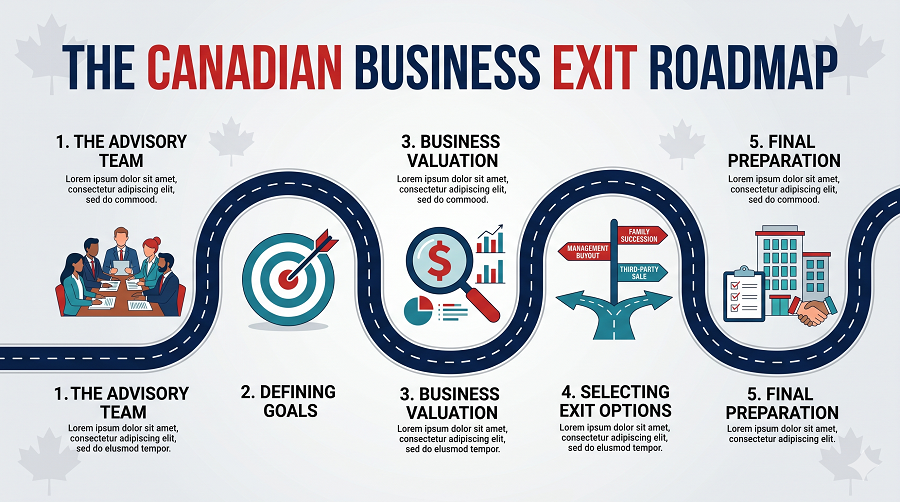
Most Canadian small business owners lose 20-50% of their exit value. Not because of poor market conditions. Because they start planning too late.
Canadian small business owners planning to sell within the next 2-5 years should begin exit planning now, not closer to the transaction date. The most valuable businesses at sale time are not necessarily the largest; they are the most transferable, systemized, and financially clean. Starting the process at least two to five years before your target date gives you the runway to build EBITDA, reduce owner dependency, resolve tax inefficiencies, and approach buyers from a position of strength rather than urgency.
Key Takeaway:
- Most Canadian business owners lose 20-50% of potential exit value due to late or poor planning—starting 2-5 years early allows you to build a transferable, systemized business and maximize the $1.25 million Lifetime Capital Gains Exemption (LCGE) plus the new Canada Entrepreneurs’ Incentive. [1]
- Key exit routes include third-party sale (highest value), management buyout (smooth transition), and family succession (legacy-focused but often discounted). Focus on growing EBITDA, reducing owner dependency, documenting systems, and cleaning financials to attract premium buyers. [1]
- Practical steps: Get a professional valuation early, purify assets for LCGE/CEI eligibility, build recurring revenue and strong management teams, prepare a CIM (Confidential Information Memorandum), and work with specialized advisors (CPA, exit coach) throughout the 9–18 month transaction process. [2]
- Warning: Waiting until burnout or market downturn weakens your position—only 30% of owners have a written plan despite 80% planning to exit within 10 years. With over $2 trillion in business assets transferring by 2033, early strategic preparation is essential. [2]
Bottom Line: A successful Canadian business exit requires proactive 2–5 year planning to maximize value, leverage major tax breaks like the $1.25M LCGE, and ensure a smooth transition—start building a sellable, systemized business today rather than leaving money on the table.
Canada offers two significant tax advantages for qualifying sellers: the Lifetime Capital Gains Exemption (LCGE), now confirmed at $1.25 million following Bill C-15 (passed February 2026), and the Canada Entrepreneurs’ Incentive (CEI), which reduces the capital gains inclusion rate to 33.3% on an additional $2 million in eligible gains. These tools can represent hundreds of thousands of dollars in tax savings, but only if your business qualifies. Qualification requires deliberate planning well ahead of the sale date.
Why Exit Planning Matters for Canadian Business Owners Right Now
According to the Canadian Federation of Independent Business, more than three-quarters of Canadian small business owners plan to exit by 2033, representing over $2 trillion in business assets changing hands. Retirement drives the majority of these exits, accounting for about 75% of cases.
And yet, research from the Business Enterprise Institute shows that while roughly 80% of owners plan to exit within 10 years, only about 30% have a written plan in place. The gap between intending to exit and being ready to exit is enormous and expensive.
Pepperdine’s Private Capital Markets Report found that 31% of business sale engagements in 2025 failed to close. The single most common reason was a valuation gap between what sellers expected and what the market would actually pay. Owners who discover this gap at the negotiating table have almost no time to fix it. Owners who discover it three years earlier can address it systematically.
The Exit Readiness Gap: Most businesses are not sale-ready when their owners believe they are. Closing that gap is the entire point of a 2-5 year exit strategy.
How Far in Advance Should You Start Exit Planning?
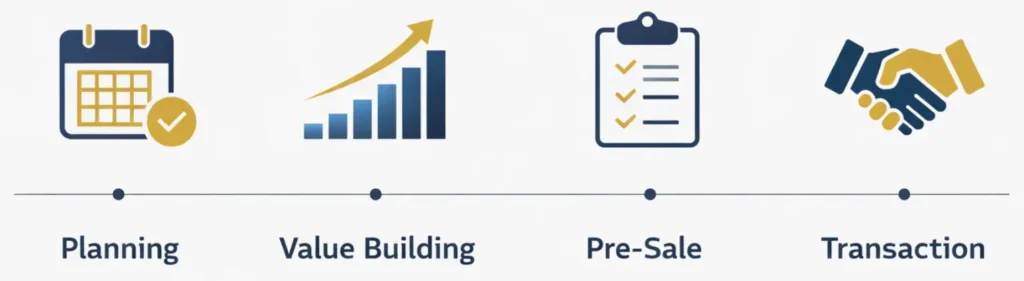
Two to five years is the consistently recommended planning window, and that window does not include the transaction itself. According to WealthCo Group, the sale process from initial buyer engagement to closing typically takes 9 to 18 months on its own. That means the preparation work needs to be finished before you ever sit across the table from a buyer.
Owners who begin planning from a position of urgency, after a health challenge, an unexpected downturn, or simple burnout, almost always leave money on the table. The best exits are engineered well in advance, not improvised when the moment arrives.
| Phase | Timeline | Focus | Priority Action |
| Early Planning | 5+ years out | Strategy + positioning | Get a valuation; set exit goals |
| Value Building | 2-4 years out | EBITDA + systems + talent | Build SOPs; reduce owner reliance |
| Pre-Sale | 12-18 months out | Financial cleanup + tax planning | LCGE qualification; audit financials |
| Transaction | 6-12 months | Buyer engagement + due diligence | CIM prepared; advisors engaged |
What Are Your Exit Strategy Options as a Canadian Business Owner?

There is no single right answer. Your optimal exit route depends on what you want most: maximum sale price, a smooth operational handover, or protecting a legacy. Understanding each option clearly helps you make the decision that aligns with your personal and financial goals.
| Exit Route | Time to Close | Value Potential | Transition Ease | Best For |
| Third-Party Sale | 6-18 months | Highest | Moderate-Low | Maximum sale price |
| Management Buyout | 12-24 months | Moderate | High | Preserving culture + team |
| Family Succession | 18-36 months | Lower (often discounted) | High | Legacy and continuity |
One important insight from KPMG Canada’s exit planning research: maximum value and easiest transition are rarely the same exit. Third-party sales typically command the highest price, but they also require the most preparation and impose the most scrutiny on your financials and operations. Management buyouts are smoother culturally but tend to come in below peak market value due to financing constraints.
How to Increase Business Valuation Before You Sell
Here is what most owners get wrong: buyers do not pay a multiple of your revenue. They pay a multiple of your EBITDA, Earnings Before Interest, Taxes, Depreciation, and Amortization. A business generating $600,000 in revenue with thin margins will always be valued lower than one generating $400,000 with strong, consistent profit.
Beyond the financials, buyers are fundamentally buying risk reduction. A business where the owner is the primary salesperson, the key relationship holder, and the only person who understands how operations run carries significantly higher risk, and buyers price that risk accordingly.
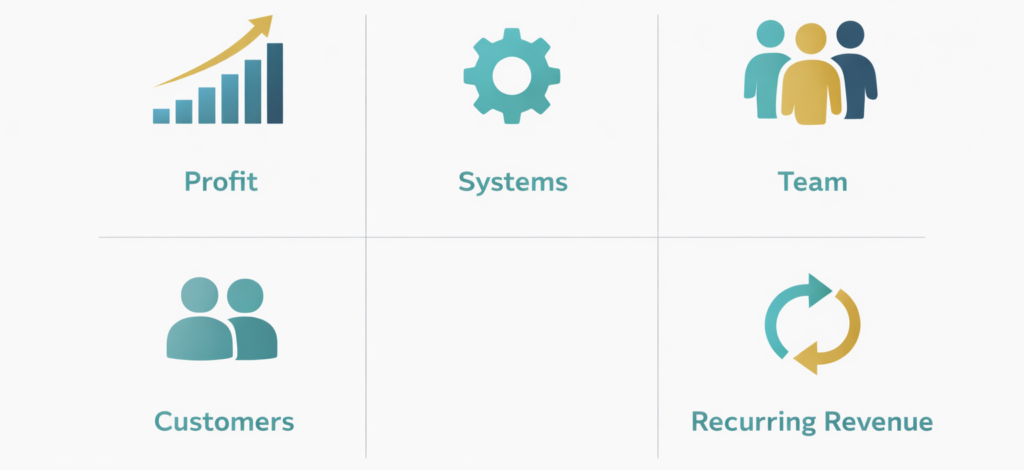
The Core Value Drivers to Address 2-4 Years Before Your Exit
| Value Driver | Impact on Price | What Buyers Look For | Action Priority |
| EBITDA Margin | High (multiplier effect) | Consistent profit trend | Start now |
| Owner Dependency | Negative (reduces multiple) | Business runs without founder | Critical – 2+ years |
| Documented Systems | High (reduces buyer risk) | SOPs, process manuals | Ongoing |
| Customer Concentration | Negative if >20% single client | Diversified revenue base | Diversify 2-4 years out |
| Recurring Revenue | High (premium multiple) | Contracts, retainers, subscriptions | Business runs without a founder |
Reinvesting profits intelligently in the years before your exit can accelerate all of these drivers. For specific reinvestment strategies that build long-term business value, see smart reinvestment strategies for Canadian business owners.
The LCGE and CEI: Canada’s Most Powerful Tax Tools for Sellers
Canada offers two interconnected tax advantages that can dramatically increase your after-tax proceeds from a qualifying business sale. Both require advance planning to access.
The Lifetime Capital Gains Exemption (LCGE)
The LCGE is now confirmed at $1.25 million per individual, following Bill C-15, which passed third reading on February 26, 2026. This means that when you sell qualifying small business corporation shares, up to $1.25 million in capital gains can be sheltered from tax entirely. For spouses who both hold shares in the corporation, that exemption can potentially be doubled through proper structuring.
To qualify, your corporation must be a Canadian-controlled private corporation, and more than 50% of its assets must have been used in active Canadian business operations for the 24 months preceding the sale. At the time of sale itself, 90% or more of assets must be used in an active business. This last requirement, often called the “purification” test, catches many business owners off guard, particularly those who have accumulated excess cash or passive investments inside the corporation over the years.
The Canada Entrepreneurs’ Incentive (CEI)
The CEI is a newer provision that reduces the capital gains inclusion rate to 33.3% on an additional $2 million in eligible capital gains beyond the LCGE. It phases in at $400,000 per year from 2025, reaching the full $2 million maximum by 2029. Note that several sectors do not qualify, including restaurants, real estate businesses, professional corporations, and financial services.
Combined, the LCGE and CEI can shelter significant capital gains from tax, but qualification requires proactive structuring years before the sale date. Work with a CPA who specializes in business exits to ensure you qualify.
The Most Common Exit Planning Mistakes
Starting Too Late
The transaction process alone takes 9 to 18 months. The value-building phase requires 2 to 4 years. Owners who decide to sell during a slow quarter, after health challenges, or when they are already burned out negotiate from a position of weakness. Urgency is the enemy of premium pricing.
Overvaluing the Business
Emotional attachment is one of the most common causes of deals falling apart. When a seller’s expectations and a buyer’s offer are far apart, neither party wins. Getting a professional, third-party valuation early, before you are emotionally committed to a number, is one of the single highest-value actions you can take.
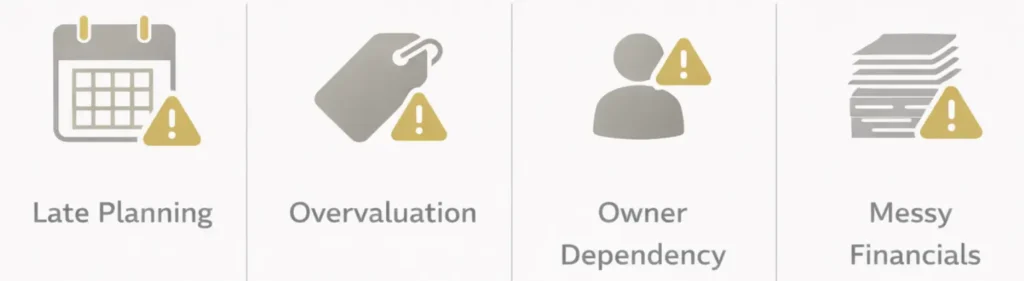
Owner-Dependent Operations
If the business cannot function without the founder’s daily involvement, buyers see it as a high-risk acquisition. For a deeper look at how this pattern develops, understanding why small businesses fail to grow reveals the operational patterns that also limit sales value.
Unclean Financials
Buyers and their advisors will scrutinize three to five years of financial records. Mixed personal and business expenses, unclear profit allocation, and inconsistent reporting create distrust and derail transactions, often after months of negotiation.
The Mindset Gap
Many business owners do not struggle with exit planning because of a lack of information. They struggle because of the internal weight of letting go. When your identity has been woven into your business for years or decades, the idea of exiting can trigger resistance, doubt, and a tendency to undervalue everything you have built.
Darren G. came to James at a point where he felt fundamentally blocked from moving forward with his career and income, unable to capture what his efforts were genuinely worth. After working through the goal blocks and limiting beliefs underneath that stagnation, he experienced shifts not just in thinking but in behavior and opportunity. The same dynamic shows up in exit planning: owners who cannot clearly see the value of what they have built, or who resist the transition emotionally, consistently leave money on the table. For owners working through that internal barrier, NLP coaching and business coaching offer a direct path to the clarity and confidence the process demands.
Who Should Be Actively Planning Their Exit Right Now?
You should start now if any of the following apply to you:
- Your business is stable or in a growth phase and you have a 2-5 year target exit window
- Daily operations rely heavily on your personal involvement and relationships
- You have not had a formal, third-party business valuation conducted
- Your financials contain personal expenses, mixed accounts, or areas that need cleanup before buyer scrutiny
- You have passive assets inside your corporation that may affect the LCGE qualification
- You want to control the terms and timing of your exit rather than being forced into a sale
Who Can Wait on Exit Planning?
You can reasonably delay formal exit planning if:
- Your business is in an early-stage growth phase where revenue and operations are not yet stable
- Your financial picture does not yet reflect the full operating capability of the business
- You are not within a 5-7 year horizon for any kind of transition or sale
Even in these cases, “waiting” does not mean ignoring the concept entirely. Building a transferable, systemized business from the beginning creates better operating discipline regardless of your exit timeline. The habits that make a business sellable are the same habits that make it profitable. For a framework to connect today’s decisions to tomorrow’s outcomes, see goal setting for business growth.
The 5X Exit Value Framework
Use this five-step process to systematically build a business that commands a premium sale price. Each step compounds the previous one, and each step requires time to implement properly.
Step 1: Financial Clarity
Get three to five years of clean, CPA-reviewed financials in order. Separate all personal expenses from business costs. Optimize your EBITDA, because buyers calculate your value as a multiple of profit, not top-line revenue. For a clear benchmark on what healthy profit looks like in your context, see how much profit a small business should be making.
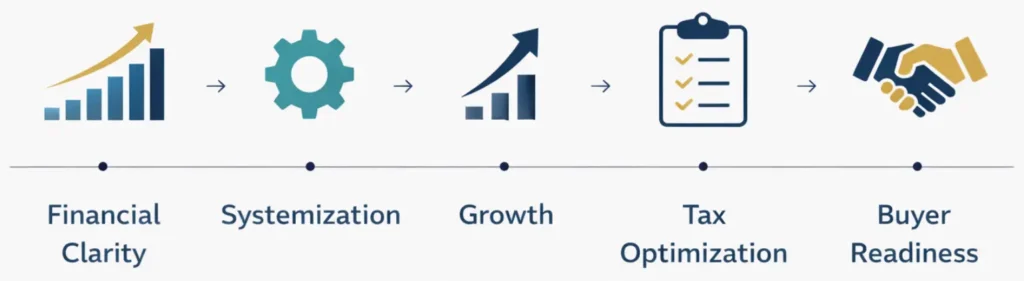
Step 2: Systemization
Document every key process in standard operating procedures. Build a management structure capable of running the business independently of your daily involvement. The more the business functions without you, the more it is worth to a buyer who cannot rely on you being there post-sale.
Step 3: Growth Positioning
Demonstrate that there is still upside. KPMG Canada’s research consistently shows that the optimal sale window is when a business is growing but has not yet reached its peak — buyers pay premiums for a visible runway. Show pipeline, under-signed contracts, or documented market expansion opportunities.
Step 4: Tax Optimization
Work with a CPA who understands the LCGE and CEI provisions well before your sale date. Ensure your corporation is “purified”; passive cash holdings and investment assets inside the corporation can disqualify you from the LCGE if not addressed in the 24-month window before the sale. Structure share ownership thoughtfully so multiple family members can access their own LCGE if eligible.
Step 5: Buyer Readiness
Prepare your documentation package in advance: a Confidential Information Memorandum (CIM), a complete asset register, all key customer and supplier contracts, and a clear ownership transition plan. Identify and begin qualifying potential buyers, strategic acquirers, private equity, or management teams, well before you are ready to list. Buyers who find a prepared business close faster and at better valuations.
Data and Findings
Based on research from major Canadian and North American financial institutions and industry reports, the following data points frame the exit planning landscape for Canadian small business owners in 2026.
- According to the Business Development Bank of Canada (BDC), more than 75% of Canadian small business owners plan to exit by 2033, with over $2 trillion in business assets expected to change hands in that period.
- Research cited by the Business Enterprise Institute shows that 80% of small and mid-sized business owners plan to exit within 10 years, yet only approximately 30% have a written exit plan.
- Pepperdine University’s Private Capital Markets Report found that 31% of business sale engagements in 2025 ended without a transaction, with a valuation gap as the leading cause.
- The LCGE is confirmed at $1.25 million per individual for qualifying small business corporation share sales, following Bill C-15, which passed third reading on February 26, 2026, and is indexed to inflation going forward.
- The Canada Entrepreneurs’ Incentive phase in from 2025, reducing the inclusion rate to 33.3% on up to $2 million in eligible gains by 2029, providing a significant compounding advantage for qualifying business sellers beyond the LCGE.
- KPMG Canada notes that owners who proactively build management depth, clean financial KPIs, and strong governance create optionality and consistently achieve better outcomes than those who sell reactively.
FAQs
When should I start planning my business exit in Canada?
Canadian business owners should start exit planning at least 2 to 5 years before selling. This timeline allows you to increase EBITDA, reduce owner dependency, clean financials, and qualify for tax benefits like the $1.25M Lifetime Capital Gains Exemption (LCGE) and the Canada Entrepreneurs’ Incentive (CEI). Starting late often reduces valuation and limits tax optimization opportunities.
How can I maximize the value of my business before selling?
To maximize business value before selling, focus on five key drivers: profitability (EBITDA), systemized operations, reduced owner dependency, diversified customers, and recurring revenue. Buyers pay higher multiples for businesses that run independently and show consistent profit growth. Improving these areas 2–4 years before exit can significantly increase your final sale price.
What is the LCGE and how does it reduce taxes when selling a business?
The Lifetime Capital Gains Exemption (LCGE) allows Canadian business owners to sell qualifying shares and avoid tax on up to $1.25 million in capital gains. To qualify, your company must be a Canadian-controlled private corporation (CCPC) and meet asset-use requirements (50% active use over 24 months and 90% at sale). Proper planning is essential to meet these criteria.
What is the best way to sell a business in Canada?
The best way to sell a business depends on your goals. A third-party sale typically delivers the highest price but requires strong preparation and due diligence. A management buyout offers a smoother transition, while family succession supports legacy continuity. Most high-value exits involve early planning, professional valuation, and strategic positioning before going to market.
What are the biggest mistakes business owners make when exiting?
The most common exit mistakes include starting too late, overvaluing the business, relying too heavily on the owner, and having unclean financial records. These issues increase buyer risk and reduce valuation. Business owners who plan early and address these gaps can avoid losing 20–50% of their potential exit value.
Your Next Step
Exiting your business is not the end of your story. It is one of the most significant financial events of your career, and it rewards the owners who prepare for it with the same intention they brought to building it.
The difference between an average exit and a premium one is rarely about market timing or luck. It comes down to strategy, structure, and clarity, developed years before the transaction is on the table.
If you are planning to exit within the next 2-5 years and you want to maximize the value of everything you have built, working with a coach who understands both the strategic and the internal dimensions of this transition makes the difference. James R. Elliot has spent 20+ years helping business owners remove the blocks that keep them undervaluing their work and underperforming their potential, so that when the moment arrives, they exit with confidence, decisiveness, and the outcome they have earned.
Unleash Your Power: Stand Out, Take Action, and Create the Success You Want.