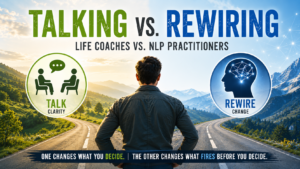

Picture this: You and your co-founder sit across from each other in the conference room, the silence so thick you could cut it with a knife. Another argument about equity splits. Another disagreement about hiring decisions. Another week of avoiding eye contact in the hallway. You wonder if this is it, if the partnership that started with so much excitement is about to implode.
Key Takeaway:
- Co-founder conflicts are one of the leading causes of startup failure, often stemming from misaligned values, unclear roles, poor communication, and differing visions for the company’s future. [1]
- Left unresolved, these conflicts can destroy trust, slow decision-making, increase stress, and even lead to the breakup of the company. However, with the right approach, most co-founder disputes can be resolved and even strengthen the partnership. [1]
- Effective resolution includes having open and honest conversations, revisiting and clarifying roles & responsibilities, using a neutral third party (like a coach or mediator), setting clear decision-making processes, and creating a co-founder agreement that outlines conflict resolution steps. [2]
- Many successful companies credit a professional coach or advisor with helping them navigate early co-founder conflicts and emerge stronger, more aligned, and better prepared for growth. [2]
Bottom Line: Co-founder conflicts are normal, but ignoring them is dangerous. Addressing issues early through open communication, clear roles, and professional coaching can prevent disaster and turn potential breakdowns into breakthroughs that make your company stronger and more resilient.
If this feels familiar, you’re not alone. Research shows that 65% of high-potential startups fail due to co-founder conflict, not market conditions or product problems. Another study found that 43% of entrepreneurs end up parting ways because of internal arguments, with 71% citing fundamental disagreements about the company’s direction. The numbers tell a brutal truth: your biggest business threat isn’t the competition. It’s the person sitting next to you at the cap table.
Here’s what most founders get wrong. They think the goal is to minimize conflict, to keep things smooth and avoid difficult conversations. But that approach actually accelerates failure. Successful co-founders don’t avoid conflict; they embrace it and transform it into fuel for better decision-making. The difference comes down to one thing: how you handle disagreement when it inevitably shows up.
Business coaching and leadership training offer powerful tools to turn toxic conflict patterns into productive collaboration. Using proven techniques from Neuro-Linguistic Programming and relationship psychology, founder teams can rebuild trust, clarify communication, and make conflict work for them instead of against them.
Why Co-Founder Conflict Is the Silent Startup Killer
Team and co-founder conflicts rank as the third most common reason startups fail, right alongside financial problems and lack of market need. Think about that for a moment. You can have the perfect product, enthusiastic customers, and money in the bank, but if you and your co-founder can’t work through disagreement, none of it matters.
The statistics paint a stark picture. When co-founder relationships fracture, 71% of the time it’s because partners disagree on the company’s direction. Another 18% split because one co-founder doesn’t share the venture’s core values. These aren’t small disagreements about office furniture or marketing taglines. These are fundamental ruptures in how you see the future.
Here’s the paradox that trips up most founders: conflict is both inevitable and necessary. You need different perspectives to make good decisions. You need someone who’ll challenge your assumptions and push back on bad ideas. The problem isn’t disagreement itself; it’s when founders don’t have the tools to navigate disagreement productively.
Common triggers include undefined roles that create constant turf battles, unequal workload perception where one founder feels they’re carrying the team, hierarchical tension when a CEO and CTO clash over decision-making authority, and evolving at different speeds where one partner wants aggressive growth while the other prefers conservative scaling. Mix in the pressure of fundraising, hiring, and market uncertainty, and you’ve got fertile ground for destructive conflict.
The toll extends beyond the business. Research shows chronic co-founder conflict weakens immune systems, increases cardiovascular risk, and leads to decision fatigue that makes strategic thinking nearly impossible. When you’re locked in recurring battles with your co-founder, burnout isn’t a possibility; it’s a guarantee.
Understanding how workplace communication breaks down helps you spot warning signs before they become catastrophic. The question isn’t whether you’ll experience conflict. The question is whether you’ll have the skills to transform it into something productive.
The Four Horsemen of Co-Founder Apocalypse
Psychologist John Gottman can predict with startling accuracy whether a marriage will end in divorce by watching for four specific behaviors he calls the Four Horsemen of the Apocalypse. The same patterns show up in co-founder relationships, and they’re just as deadly.
Defensiveness is the first horseman. When your co-founder raises a concern and your immediate response is “You always do this” or “That’s not fair, I work harder than anyone,” you’ve shifted from listening to protecting yourself. Defensiveness shuts down dialogue and makes the other person feel unheard.
Criticism attacks character instead of addressing specific behaviors. There’s a difference between “You missed the deadline we agreed on” and “You’re unreliable and never follow through.” One opens a conversation about improving systems. The other damages the relationship.
Contempt is the most toxic horseman. Eye rolls during your co-founder’s presentations. Sarcastic comments in team meetings. Dismissive body language that signals disrespect. When contempt enters the picture, the relationship is in serious trouble.
Stonewalling means you’ve given up on resolving the issue. You schedule meetings and cancel them. You respond to messages with one-word answers. You avoid being in the office at the same time. I’ve seen founders take this to extremes. One recently told me he decided to talk to his co-founder only once a month, claiming it was the only way forward. That’s not conflict management. That’s relationship death.
If you find yourself dodging your co-founder in the hallway, canceling one-on-ones, or keeping interactions to the bare minimum, you’re not protecting the partnership. You’re accelerating its demise.
These patterns are reversible, but only if you’re willing to do the hard work of changing how you engage with conflict. That’s where coaching comes in.
How Coaching Disrupts Toxic Conflict Patterns
Most founders resist getting outside help. There’s stigma around admitting you need support, cost concerns, and the “we can figure it out ourselves” mentality that drives entrepreneurs in the first place. But here’s what that resistance misses: coaching isn’t therapy. It’s strategic relationship optimization for business success.
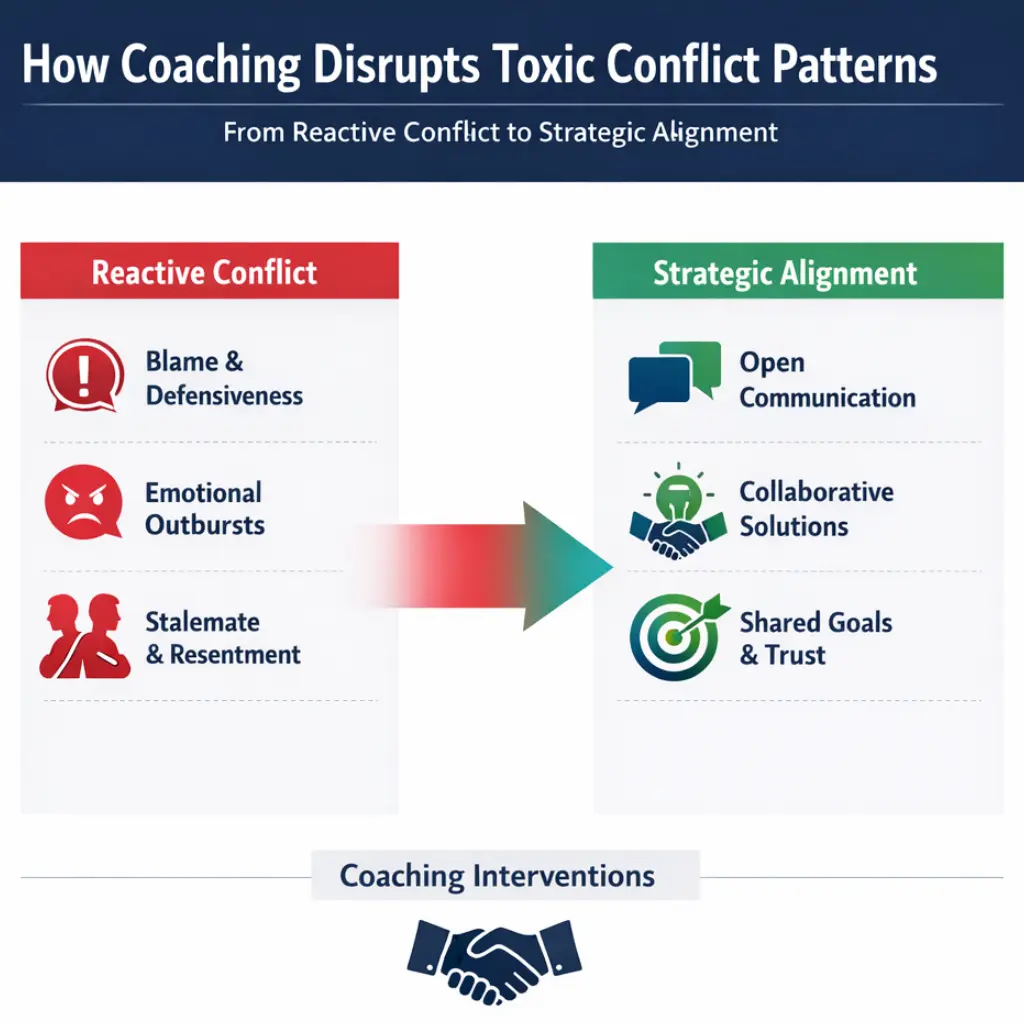
Think of it this way. You wouldn’t try to scale your infrastructure without technical expertise. You wouldn’t fundraise without understanding venture dynamics. Why would you try to navigate high-stakes relationship conflict without proven frameworks?
Neuro-Linguistic Programming offers particularly powerful tools for resolving co-founder disputes. NLP coaching techniques help you understand how your brain processes conflict, how language patterns reveal deeper beliefs, and how to shift perspective in ways that transform stuck situations.
Reframing changes the meaning you assign to your co-founder’s behavior. When you interpret “they made a decision without me” as disrespect, you trigger a defensive response. When you reframe it as “we have different decision-making speeds that we need to clarify,” you open space for productive conversation. The facts haven’t changed; your interpretation has.
Perceptual Positions is an exercise that has you literally sit in different chairs representing yourself, your co-founder, and a neutral observer. Walking through a disagreement from each perspective creates empathy and reveals blind spots. You discover that what feels like stubbornness from your view looks like principled conviction from theirs.
The Meta Model exposes the generalizations that escalate conflict. “You never listen to me” feels true when you’re frustrated, but it’s rarely accurate. A coach trained in NLP helps you separate facts from interpretation. What actually happened in that meeting? What specific behaviors triggered your response? When you get concrete, solutions become clearer.
Rapport techniques help you match communication styles to reduce friction. If your co-founder processes information visually and you’re throwing auditory metaphors at them, messages get lost in translation. Understanding and adapting to different thinking styles transforms how you connect.
One of my clients, Mike, struggled with self-doubt and anxiety that created constant mental noise, the same pattern I see in founders avoiding tough conversations. Through NLP techniques like reframing and anchoring, Mike eliminated his anxiety and now communicates assertively in high-stakes situations, exactly what co-founders need to resolve conflict productively.
The goal isn’t to eliminate disagreement. The goal is to build the capacity to disagree without destroying trust.
What Hurts More, That They Did It, or That They Did It Without You?
Couples therapist Esther Perel asks co-founders a diagnostic question that cuts straight to the root of conflict: “What hurts you more? The fact that they did it in the first place or that they did it without you?”
Your answer reveals everything about what’s actually broken in your partnership.
If what hurts most is that they did it in the first place, you’re dealing with a power conflict. You disagree about the decision itself. You think they chose wrong. You believe your judgment is better. These conflicts center on control, authority, and who gets to steer the ship.
If what hurts most is that they did it without you, you’re dealing with a closeness conflict. The issue isn’t the decision; it’s the broken trust. You thought you were building this together. You expected to be consulted. You feel sidelined, dismissed, like the partnership isn’t real. These conflicts come back to “I thought I could count on you” statements and shattered assumptions about the relationship.
Understanding which type of conflict you’re experiencing changes how you approach resolution. Power conflicts require clarifying roles, decision-making frameworks, and areas of authority. You need structure and agreements. Closeness conflicts require rebuilding trust, improving communication patterns, and reconnecting around shared purpose. You need emotional repair work.
Most co-founder fights involve both elements, but one usually dominates. Getting clear on the real issue prevents you from applying the wrong solution.
The 4-Step Framework for Resolving Co-Founder Conflict
Based on research from startup accelerators and relationship psychology, here’s a practical framework for transforming conflict from partnership-killer to competitive advantage.
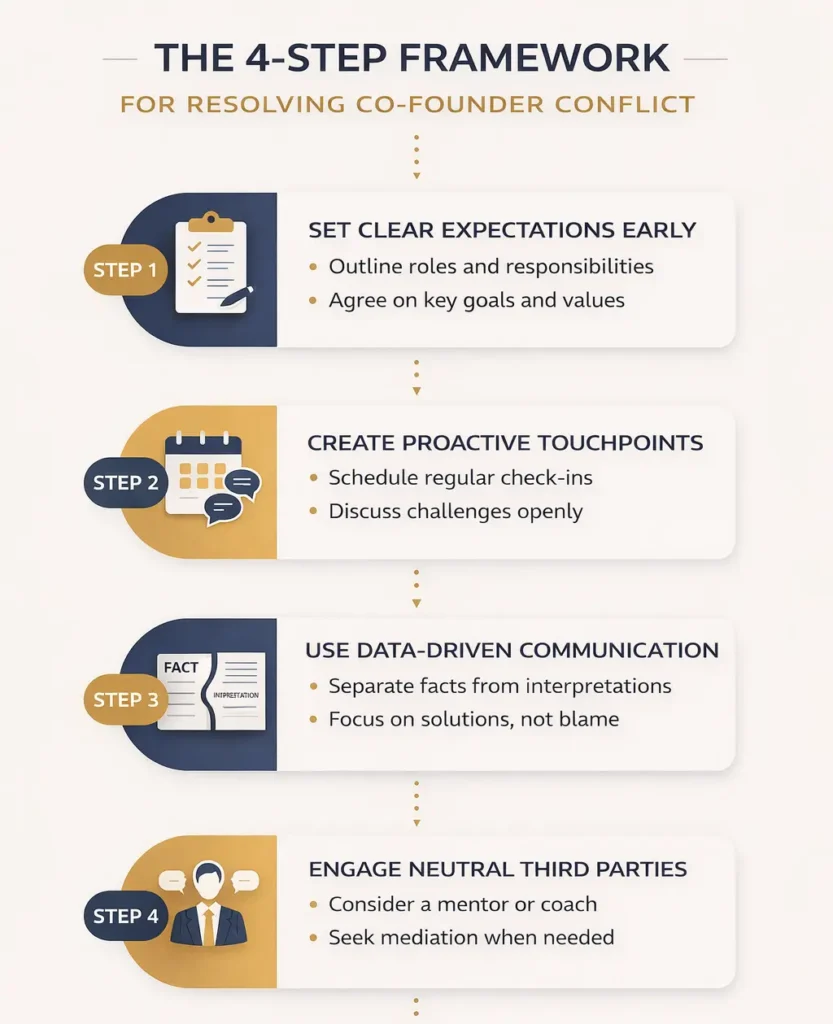
Step 1: Set Clear Expectations Early (Prevention Mode)
The biggest regret among founders who’ve gone through messy co-founder splits? Not catching misaligned expectations until it was too late.
Start by aligning on vision. Do you both want to IPO in seven years? Exit after a strategic acquisition? Build a sustainable lifestyle business? These aren’t small differences; they fundamentally shape every decision you make.
Document your conflict resolution process in your founder agreement. What happens when you disagree on major decisions? Who has final say in different domains? How will you bring in an outside perspective when you’re stuck? Getting this in writing before you’re in crisis prevents destructive patterns from taking hold.
Clarify roles and responsibilities with specificity. “I handle product” sounds clear until you’re arguing about whether pricing belongs to product or business strategy. Define not just what you own, but where boundaries overlap and how you’ll navigate shared territory.
Create a decision-making authority map. Which decisions require unanimous agreement? Which ones can each founder make independently? When do you consult the other versus inform them after the fact? Ambiguity in decision rights creates constant friction.
Step 2: Create Proactive Touchpoints (Maintenance Mode)
Successful co-founders don’t wait for explosions. They normalize difficult conversations through regular check-ins.
Schedule weekly or biweekly “state of the union” meetings. Not for operational updates for relationship health. What’s working? What’s creating tension? What do you each need to move forward more effectively? Sometimes clearing the air takes ten minutes. Sometimes it takes two hours. Make the space.
Plan quarterly off-sites away from the office. Go on a hike. Rent a cabin. Take a long walk near water. Physical distance from the pressure cooker of startup life creates room for honest reflection. You’ll have conversations over coffee that never happen in conference rooms.
Spending time together outside work builds the relational foundation you’ll need when conflict hits. If your only interactions are tense meetings about cash runway and customer churn, you’ve got nothing to fall back on when disagreement escalates.
Step 3: Use Data-Driven Communication (De-escalation Mode)
When emotions run high, grounding conversation in facts prevents destructive spirals. The proven fact versus interpretation exercise is simple but powerful.
Take a piece of paper and draw a line down the middle. On the left side, write only the facts that you can prove in reality. Numbers. Specific things someone said or did. Observable behaviors. You’ll likely find the facts are simple and there aren’t many of them.
On the right side, write your interpretation. The story you’re telling yourself about what those facts mean. Two people rarely share the exact same interpretation, so this exercise opens space for both of you to share experiences instead of arguing about whose reality is correct.
Example: Fact = “We didn’t discuss the hiring decision before you posted the job ad.” Interpretation = “You don’t value my input and think you can make all the decisions.”
The fact is specific and indisputable. The interpretation is one possible meaning, not the only meaning. When you separate the two, you can address what actually happened without getting tangled in emotional narratives.
Don’t dismiss emotions in pursuit of data. How you feel matters; feelings reveal your motivations, values, and underlying needs. But name emotions for what they are: your reaction to your interpretation, not the objective truth about the situation.
Step 4: Engage Neutral Third Parties (Intervention Mode)
You know you need outside help when you find yourselves having the same argument on repeat, when avoidance behaviors become the norm, when trust feels broken and you can’t rebuild it on your own, or when one of you has started seriously considering asking the other to leave.
Options include business coaches who specialize in founder dynamics, co-founder therapists trained in relationship repair for business partners, and trusted advisors or mentors who’ve navigated similar challenges. Leadership coaching programs often include conflict resolution frameworks specifically designed for high-stakes business relationships.
The value of a third party isn’t that they have magic answers. It’s that they translate emotional friction into actionable steps, hold both of you accountable to showing up and doing the work, offer perspective you can’t see from inside the conflict, and create a structured space for difficult conversations.
Many accelerator programs now offer conflict mediation alongside business strategy support. They’ve seen too many promising companies die from founder conflict to ignore the relationship component. You have a board that helps with fundraising tactics and resource management. Why not add an advisor who helps you stay connected to each other and the company?
Can a Co-Founder Conflict Actually Be Healthy?
Yes, when handled productively, conflict drives innovation and prevents dangerous groupthink.
Healthy conflict shows up as debate over product direction, disagreement about market strategy, different opinions on hiring decisions, and competing perspectives on how to allocate resources. Different viewpoints sharpen thinking. Challenge prevents you from charging down a path that looked brilliant at 2 am but falls apart under scrutiny.
Unhealthy conflict looks like personal attacks that question character instead of addressing behaviors, trust erosion where you start assuming bad intent, avoidance and stonewalling that prevent resolution, and contempt that poisons every interaction.
The key distinction: Successful co-founders embrace disagreement and commit to a resolution process. They don’t leave the room until they’ve reached alignment, even if that means canceling weekend plans and going on a long hike to work through a thorny issue. If you can’t argue and arrive at the best solution together, you’re not doing the partnership work required for a healthy relationship.
The strongest companies aren’t built by co-founders who always agree. They’re built by co-founders who’ve learned to disagree productively.
When to Walk Away: Recognizing Unsalvageable Conflict
Not every partnership is meant to last. Sometimes the healthiest choice is an amicable exit.
Red flags that signal it might be time to part ways include your co-founder consistently refusing to work on the relationship when you’ve raised concerns multiple times, patterns of violating agreements even after committing to change, fundamental values misalignment around ethics, work ethic, or company purpose, and persistent contempt and stonewalling that continue even after coaching intervention.
Here’s the hard truth: if your co-founder isn’t willing or able to build a productive, emotionally healthy working relationship, do you want to invest the next decade trying to force it? Some relationships reach a point where staying causes more damage than leaving.
The reframe: Ending a partnership isn’t failure. It’s strategic decision-making based on a clear assessment of whether you can build something great together.
When you reach this point, legal structure protects both parties through proper documentation of exit terms, but litigation should be your last resort. Legal battles are expensive, time-consuming, and damage your startup’s reputation. Exhaust coaching and mediation first. If the relationship truly can’t be saved, work with an experienced business attorney to structure an exit that preserves value for the company and dignity for both founders.
How Do I Know if We Need a Coach or a Lawyer?
Start with a coach. Escalate to a lawyer only if the relationship is beyond repair or legal violations have occurred.
Choose coaching when you’re dealing with communication breakdowns where conversations go nowhere, recurring arguments about the same issues without resolution, trust issues that create tension and distance, feeling stuck and unable to move forward, or avoidance patterns where you’re minimizing contact.
Bring in a lawyer when you’re facing breach of fiduciary duty or ethics violations, intellectual property disputes that require legal clarity, forced buyouts where one founder wants immediate exit, or situations where one party refuses all attempts at resolution and legal action is the only remaining path.
Eight-week coaching intensives focused on co-founder conflict disruption can rebuild trust before legal battles destroy company value. Coaching addresses the relationship dynamics that created the conflict. Legal intervention addresses the mechanics of separation once the relationship is definitively over.
In most cases, you’ll get better outcomes by investing in relationship repair first.
Frequently Asked Questions
Why Do Most Co-Founder Partnerships Fail?
Research shows that 65% of high-potential startups fail due to co-founder conflict, often stemming from “The Four Horsemen”: defensiveness, criticism, contempt, and stonewalling. Most disputes arise from misaligned visions, undefined roles, or a “pursue-withdraw” communication pattern where one partner pushes for resolution while the other retreats.
Can Coaching Really Save a Failing Co-Founder Relationship?
Yes. Unlike traditional therapy, co-founder coaching is a strategic business intervention that uses frameworks like NLP (Neuro-Linguistic Programming) to disrupt toxic patterns. It helps founders separate objective facts from emotional interpretations, rebuild trust through rapport-building techniques, and transform destructive arguments into productive debates.
What Is the “Fact vs. Interpretation” Exercise in Conflict Resolution?
This is a de-escalation tool where founders list indisputable facts (e.g., “A meeting was missed”) separately from their interpretations (e.g., “My partner doesn’t respect my time”). By isolating the “story” from the reality, partners can address specific behaviors without triggering the defensive spirals that typically lead to partnership implosion.
How Can NLP Techniques Help Resolve Founder Disputes?
NLP offers practical tools like Perceptual Positions, which force founders to view a conflict from their partner’s perspective and a neutral observer’s view. Techniques such as reframing allow founders to shift their mindset from seeing a partner as “stubborn” to seeing them as “principled,” opening the door for collaborative problem-solving.
When Should Co-Founders Choose a Coach Over a Lawyer?
You should hire a coach when there is a breakdown in communication, recurring arguments, or a loss of trust, but both parties still want the business to succeed. A lawyer should only be the primary contact if there is a breach of fiduciary duty, ethical violations, or if the relationship is definitively unsalvageable and requires a legal exit.
Your Next Move: Building Unbreakable Founder Alignment
You’re not alone. Every founder team experiences conflict 100% of the time. The difference between teams that thrive and teams that implode comes down to how they respond when disagreement shows up.
You have a choice. You can avoid difficult conversations, minimize contact, and watch trust erode until the partnership collapses. Or you can embrace conflict as an opportunity to get clearer, communicate better, and build a relationship resilient enough to weather the inevitable storms of building a company.
Coaching isn’t a luxury for founder teams; it’s a competitive advantage. While your competitors are burning energy on internal battles and letting resentment poison decision-making, you’re transforming conflict into fuel for innovation. NLP tools like reframing, rapport-building, and perceptual positions give you practical frameworks for navigating disagreement without destroying the partnership.
Here are three action steps you can take this week:
- Schedule a “state of the union” conversation with your co-founder. Set aside two hours with no agenda except checking in on the relationship.
- Try the fact versus interpretation exercise on your biggest current tension. Write down the observable facts separately from the story you’re telling yourself about those facts.
- Consider whether you’d benefit from an outside perspective. If you’re having the same arguments on repeat or avoiding each other, that’s your signal.
Ready to transform conflict into your startup’s superpower? Our Business Coaching programs equip founder teams with proven NLP techniques to resolve disputes, rebuild trust, and make better decisions together. OurLeadership Training certification helps you master communication skills that turn disagreement into productive collaboration.
The foundation of your startup isn’t your code, your pitch deck, or even your product. It’s the trust between the people building it. Invest in that foundation through NLP training and coaching, and you’ll build something that lasts.
Book a discovery call today and save your partnership before it’s too late.