
You’ve just invested thousands of dollars and weeks of your time earning your NLP certification. The certificate looks impressive on your wall. You know all the techniques: anchoring, reframing, submodalities, the Meta Model. You passed the exam. You’re officially certified.
Key Takeaway:
- NLP (Neuro-Linguistic Programming) Certification is highly valuable when applied correctly. It equips coaches, leaders, and professionals with powerful tools for communication, mindset shifts, overcoming limiting beliefs, and influencing behavior — far beyond just theory. [1]
- The real-world impact of NLP comes from practical application: reframing negative thoughts, building instant rapport, using language patterns to motivate clients, breaking through procrastination or fear, and helping people achieve faster breakthroughs in coaching, sales, leadership, and personal development. [1]
- Choose a reputable, hands-on NLP certification that includes live practice, feedback, and real client application rather than purely online theory-based programs. The best certifications combine classroom training with supervised practice and ongoing support. [2]
- When used ethically and skillfully, NLP can dramatically improve your effectiveness as a coach, leader, or entrepreneur — leading to better client results, stronger relationships, and higher income. [2]
Bottom Line: NLP Certification is much more than a credential — it’s a practical toolkit for transformation. Choose a quality program with real-world application, apply the techniques consistently and ethically, and you’ll see powerful results in coaching, leadership, communication, and personal growth.
Then you sit down with your first real client, and something uncomfortable happens: you freeze. You know what the techniques are called, but you have no idea which one to use right now, in this moment, with this person’s actual problem staring you in the face. The gap between what you learned in the course and what you need to do in the real world suddenly feels massive. You’re not alone in this experience. The NLP industry has created thousands of “paper practitioners,” people who can recite techniques but struggle to apply them when it matters. The problem isn’t NLP itself. The methodology is powerful when applied correctly. The problem is how most comprehensive NLP training programs are structured, prioritizing attendance over competence and theory over practice. If you’re considering NLP certification, this article will show you exactly how to identify programs that actually develop skill, not just hand out certificates. The difference could save you thousands of dollars and years of frustration or transform your professional coaching certification into genuine expertise.
The Hidden Crisis in NLP Certification
Why Attendance Doesn’t Equal Competence
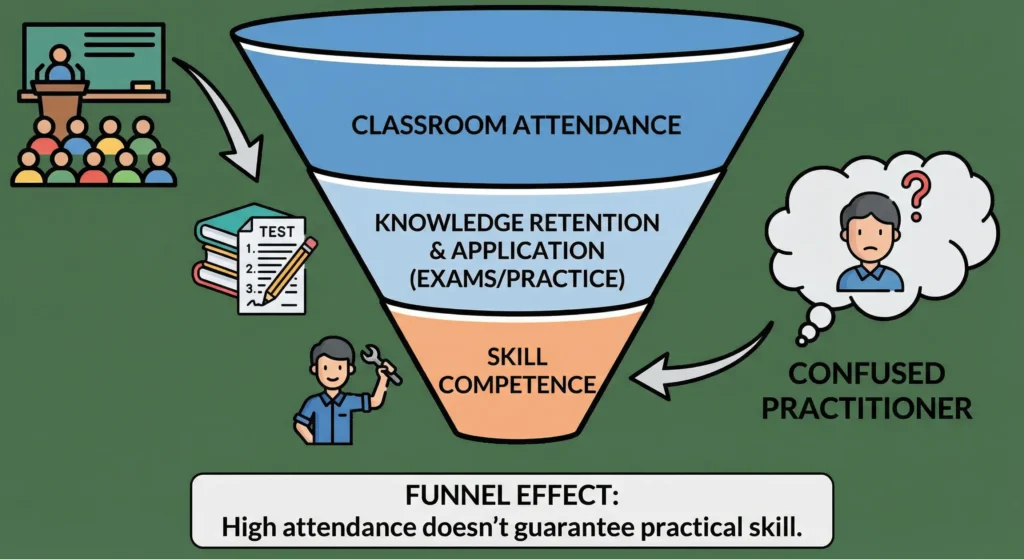
The NLP certification industry has a dirty secret: most programs award certificates based on seat time, not skill demonstration. You show up, you watch the presentations, you participate in the exercises with other students, and at the end, you get your certificate. Congratulations, you’re now a certified practitioner who may or may not actually be able to help anyone.
Quick certifications leave practitioners struggling with decreased effectiveness in their skillset. The rise of weekend intensives and video-only programs has created a generation of NLP practitioners who understand concepts but can’t implement them. They’ve memorized the parts of the communication model but don’t know how to read someone’s eye accessing cues in the middle of an actual conversation. They know anchoring exists but panic when trying to set one under real-world conditions.
The numbers tell the story: many programs advertise 60-120 hours of training time. Sounds substantial, right? Except when you break it down, that’s mostly lecture and demonstration, with minimal supervised practice. You might spend 100 hours watching someone else do NLP and only 20 hours actually doing it yourself and those 20 hours are often with other students who are just as confused as you are.
This approach works great for the training companies. They can certify more people in less time, charge premium prices, and move on to the next cohort. But it fails the students who genuinely want to develop competence. Traditional competence-based certification models recognize this problem by requiring demonstrated behavioral skill and real-world application rather than just attendance or course hours. That’s the difference between knowing and doing.
The Theory-Practice Gap Nobody Talks About
Here’s what actually happens after most people finish their NLP certification: they feel lost. They have notebooks full of techniques, but when they try to use them with real people facing real problems, nothing quite fits. The clean examples from the training room don’t match the messy reality of human behavior.
Heather Chetwynd experienced this firsthand. She had completed NLP training before, learning all the standard techniques and models. But as she described it, she “left feeling confused about how things fit together and how to integrate the approach into my work.” She knew the pieces but couldn’t see how they connected or when to use what. It wasn’t until she took training with James R. Elliot that everything clicked. As she put it, “James pulled it all together, clarifying how everything fit together and helping me discover how to integrate the knowledge and techniques into my work.”
Heather’s experience captures the core problem: most programs teach you what NLP techniques are without teaching you how to actually use them in context. They give you a toolbox but no blueprint. You learn that reframing changes meaning, but nobody shows you how to identify when someone needs a reframe versus when they need an anchor or a values elicitation. You practice rapport skills with fellow students who are cooperative and motivated, but nobody prepares you for a skeptical client who’s resistant to the process.
The classroom environment creates a false sense of competence. Everyone’s on the same page, learning the same material, trying to help each other succeed. Of course, the techniques work in that setting. The real test comes when you’re working with someone who doesn’t know NLP exists and doesn’t care about your fancy certificate. They just want help with their problem, and they want it now.
Three Critical Elements Missing from Most Programs
Element 1: Live, Interactive Feedback Sessions
Pre-recorded videos have their place in learning theory and foundational concepts. You can watch, pause, rewind, and review at your own pace. But you cannot develop NLP skills by watching videos alone. Skills require correction. You need someone watching you practice who can say, “Your tonality shifted there and broke rapport,” or “You’re rushing past their emotional state instead of pacing it first,” or “That reframe was brilliant, now anchor that new perspective.”
The experiential learning model that quality programs use provides unlimited live sessions where you can practice techniques and get immediate feedback from experienced trainers. This isn’t a nice-to-have feature. It’s absolutely essential for skill development. When you’re learning to calibrate someone’s state, you need a trainer to tell you what you’re missing. When you’re practicing language patterns, you need someone to catch the subtle ways you’re triggering resistance instead of creating openness.
Think about learning any complex skill. Would you trust a surgeon who learned exclusively from videos? Would you hire a pilot who never had an instructor in the cockpit correcting their mistakes? Of course not. Yet somehow, we expect people to develop sophisticated communication and change work skills without direct supervision and feedback.
Quality programs build this into their structure from the beginning. They include breakout rooms where you practice with peers while trainers rotate through, observing and coaching. They record your practice sessions so you can review them with a trainer later. They create accountability for actually using the techniques, not just knowing about them. This is how NLP in business contexts becomes effective rather than theoretical.
Element 2: Supervised Real-World Application
Here’s where most programs completely fall apart: they never require you to work with actual clients under supervision. You practice with fellow students, and then suddenly you’re certified and on your own. That’s like earning a driver’s license by only driving in an empty parking lot with other student drivers.
Real competence comes from working with people who have genuine problems they want solved, not from doing exercises with classmates who are playing along. Comprehensive training requirements include about 20 days of full training over several months, with clinical components where you work with members of the public under close supervision.
This changes everything. When you’re working with someone who didn’t sign up to be your practice subject, who has a real issue causing them real pain, the stakes shift. You can’t just go through the motions. You have to actually calibrate their state, build genuine rapport, choose the right intervention, and help them get results. And you need a skilled trainer watching to guide you when you get stuck, correct you when you miss something important, and validate that you’re on the right track.
Some of the best programs require you to record sessions with volunteer clients and submit them for review. The trainer watches your work and provides detailed feedback on what you did well and where you need to improve. This kind of accountability ensures you’re not just hoping you’re doing it right; you’re getting expert confirmation that your skills are developing properly.
This is also where continuous professional development becomes critical. One round of supervised practice isn’t enough. You need ongoing opportunities to work with real people, get feedback, refine your approach, and build genuine fluency.
Element 3: Ongoing Support Beyond Certification
Here’s the moment that reveals whether you chose a quality program or not: the day your certification ends. Do you suddenly feel abandoned, or do you have continued access to support, resources, and community?
Most programs end with your certificate presentation. You’re now on your own. Good luck figuring out how to apply what you learned when real-world situations don’t match the clean examples from training. Hope you took good notes.
Quality programs recognize that learning doesn’t stop at certification. They provide alumni practice groups where you can continue refining skills with peers. They offer ongoing access to trainers via email or scheduled office hours. They create communities where practitioners share challenges and solutions. They keep you connected to the training team, who can answer questions as you navigate applying NLP in your specific context.
This ongoing support serves another crucial function: accountability. When you know you’ll be reporting back to your practice group or trainer about how you’re using the techniques, you’re far more likely to actually use them. Without that external accountability, it’s too easy to fall back into old patterns and let your expensive certification gather dust.
The best programs also provide pathways for continued development. Once you’ve integrated the practitioner-level skills, you have clear options for advancing to master practitioner, specialized coaching certification, or even trainer certification. This creates a long-term relationship focused on genuine mastery, not just a one-time transaction.
How to Spot Red Flags vs. Green Flags in NLP Programs
Red Flags That Scream “Theory Only”
If a program promises you can “master NLP in a weekend,” run. If they advertise “instant certification” or emphasize how quickly you can get certified, that’s your first warning sign. Genuine skill development takes time. There are no shortcuts to competence.
Purely self-paced online programs with no live components should raise immediate concerns. Yes, you can learn concepts from videos. No, you cannot develop skills without someone watching you practice and providing corrections. If the entire program consists of watching pre-recorded content and taking quizzes, you’re buying a certificate, not building capability.
Look closely at the practice requirements. If there aren’t any, or if all the practice is just with other students in the course, that’s a massive red flag. You need to work with real people facing real problems, and you need supervision while you’re doing it. Programs that skip this step are setting you up to fail when you try to apply NLP in the real world.
Check the trainer’s background carefully. Do they actually use NLP with clients, or do they only teach? Teaching and doing are different skills. You want someone who actively applies NLP in their own practice, not just someone who can explain the concepts. If their primary experience is “20 years teaching NLP” but they haven’t worked with clients in years, that’s a problem. You’re learning from someone whose skills may have atrophied or who never developed real-world fluency in the first place.
Watch for overcomplicated or significantly altered techniques. Some trainers take the original NLP models and add layers of complexity or merge them with other approaches until the technique becomes unrecognizable. This often happens because the trainer doesn’t fully understand the original model, so they compensate by making it more elaborate. Original NLP is elegant and straightforward. If it’s being presented as overly complex, question why. Understanding online NLP training differences helps you spot when programs are adding unnecessary complexity to justify their pricing.
Green Flags of Application-Focused Training
The first green flag is emphasis on competence testing rather than just attendance hours. Quality programs assess whether you can actually perform the skills, not just whether you showed up and sat through the lectures. They require demonstrations where you prove you can calibrate state changes, build rapport with diverse personalities, execute clean language patterns, and facilitate actual change work.
Look for programs that mandate live practice with qualified trainer feedback. This should be built into the structure, not offered as an optional add-on. The best programs include regular live sessions daily or multiple times per week, where you practice with peers and receive real-time coaching from experienced trainers watching your work.
Strong programs require you to demonstrate skills with real people, not just course members. This might mean working with volunteer clients, recording sessions for trainer review, or conducting supervised sessions with members of the public. If the program doesn’t push you outside the comfort zone of the training room, you’re not being prepared for real-world application.
Verify the trainer’s lineage. Quality trainers can trace their training back to the founders of NLP, either Richard Bandler or John Grinder. This doesn’t mean they learned directly from the founders (though some did), but they can show a clear training lineage. Their teachers were certified by someone who was certified by someone, and eventually that chain leads back to the source. This matters because it helps ensure the techniques you’re learning haven’t been significantly diluted or distorted over time.
Pay attention to whether the program helps you integrate NLP into your existing professional context rather than treating “NLP practitioner” as a separate career. The most valuable training shows you how to use NLP tools in whatever work you already do coaching, therapy, business leadership, sales, education. This focus on integration rather than isolation dramatically increases the chances you’ll actually use what you learn. Following professional training standards helps ensure your training will be recognized and respected in professional contexts.
Is an NLP Certification Worth It If Done Right?
Yes, when you choose a program that prioritizes practical application over paper credentials, NLP certification can transform how you work with people.
The evidence is clear. Properly trained practitioners report dramatic improvements in their ability to facilitate change, lead teams, negotiate successfully, and communicate with influence. Mike L.’s story illustrates what happens when NLP training emphasizes real-world application. His anxiety vanished, his confidence surged, and he transformed his career trajectory by applying NLP techniques in actual work situations. That’s not theory, that’s competence in action.
Darren G.’s experience shows another dimension. He was stuck in his career despite having a well-paying job. Through training that focused on identifying and eliminating goal blocks using NLP techniques, he experienced “radical shifts in my thinking, my behaviors, and my life.” His relationships improved as a side effect. That’s what real NLP competence delivers, not knowledge about techniques, but the ability to facilitate genuine transformation.
The business applications are substantial. Organizations are increasingly recognizing that NLP for improving employee retention and NLP techniques for team building provide practical tools for addressing communication breakdowns, resolving conflicts, and creating high-performing teams. But these benefits only materialize when the practitioners involved have genuine skill, not just certificates.
The caution is this: the value comes entirely from your ability to use the techniques effectively. A certificate on your wall means nothing if you can’t help people when it matters. Choose training that develops real competence, and NLP certification becomes one of the most valuable investments you can make in your professional development. Choose training that just hands you a certificate, and you’ve wasted your time and money.
What Does Real-World Application Actually Look Like?
Beyond the Classroom: Integration That Matters
Real-world application doesn’t mean becoming a full-time “NLP practitioner” who only does NLP change work. For most people, effective application means integrating NLP tools into their existing professional context using rapport skills in business negotiations, employing reframing in team meetings, applying anchoring techniques with coaching clients, or utilizing Meta Model questions to resolve conflicts.
Mike L. provides a perfect example. He didn’t leave his career to “do NLP.” He applied the techniques he learned to his actual work environment. His anxiety diminished because he could now manage his state. His career trajectory changed because he learned to communicate with confidence. He stopped second-guessing himself in important conversations because he had practical tools for maintaining resourceful states under pressure.
This is what the application looks like: using anchoring before a difficult presentation so you can access confidence when you walk into the room. Employing sensory acuity during negotiations so you can calibrate whether your proposal is landing well or creating resistance. Using the Meta Model to get clarity when someone gives you vague feedback. Applying reframing when your team sees obstacles instead of opportunities.
The difference between knowing about anchoring and actually using it under pressure is massive. Knowing about it means you can explain the concept. Using it under pressure means that when you’re about to walk into a high-stakes situation, you automatically access the anchor you set, shift into a resourceful state, and perform at your best. That’s competence. That’s what quality training develops. Implementing daily NLP integration strategies becomes natural when your training emphasizes practical application from the beginning.
The Accountability Factor
Self-study falls short precisely because there’s no external accountability for application. You can watch all the videos, read all the books, and understand all the concepts without ever actually using the techniques with real people. Knowledge without application doesn’t produce results.
Quality training builds in accountability mechanisms. You’re expected to practice between sessions and report back. Your trainer checks whether you’re implementing techniques in your daily life. You’re part of a practice group where peers ask, “What did you apply this week, and what happened?” This external accountability ensures you’re not just consuming information you’re actively developing skill.
Some programs require specific application assignments: use rapport skills in three different contexts this week and report what happened. Set an anchor for confidence and test it in a real situation. Use the Meta Model to clarify vague communication and document the results. These assignments force you to bridge the gap between classroom learning and real-world doing.
The behavioral competence standards used by quality programs require demonstrated capability in actual situations, not just theoretical knowledge. This approach recognizes that NLP only works when applied, and application only happens consistently when there’s accountability driving it.
Are There NLP Certifications That Get It Right?
Yes, look for programs that combine three non-negotiables, and you’ll find training that actually develops competence rather than just awarding certificates.
The Three Non-Negotiables:
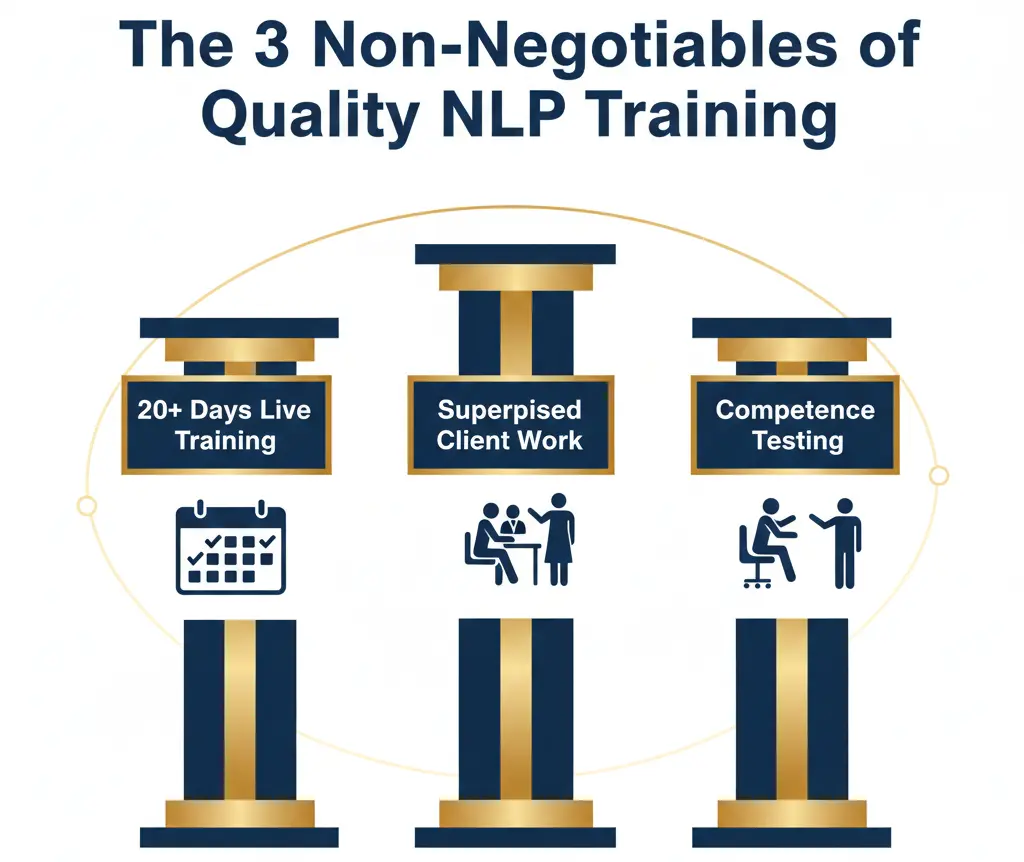
1. Substantial Live Training Time
Not weekend intensives. Not 3-day crash courses. Genuine practitioner-level competence requires 20+ days of comprehensive training spread over several months. This time frame allows you to learn techniques, practice them, apply them in your life, come back with questions, receive feedback, and integrate the learning. Established training standards set a minimum of 120 hours for practitioner certification, recognizing that genuine skill development cannot be rushed.
2. Supervised Practice With Real Clients
Not just role-playing with fellow students. You need to work with real people who have genuine problems, under the supervision of a qualified trainer who can guide you when you get stuck. This might mean volunteering clients coming in for supervised sessions, recording your sessions for trainer review, or working in a clinical setting where experienced practitioners oversee your work. Programs that skip this element are setting you up to be a theoretical practitioner rather than an effective one.
3. Competence Evaluation
Assessment should focus on demonstrating skills, not passing written tests. Can you build rapport with someone who has a different primary representational system than yours? Can you calibrate subtle state shifts? Can you execute clean language patterns without fumbling? Can you choose the right intervention for a given situation? These are the questions that matter, and they can only be answered through demonstration, not multiple-choice exams.
What to Ask Before Enrolling:
Before you commit to any NLP certification program, ask these questions directly:
“How many hours of live, trainer-led practice are included?” If the answer is vague or emphasizes self-paced study, that’s a warning sign.
“Will I work with real clients under supervision, or only with other students?” If there’s no requirement to work with real people, you’re not being prepared for real-world application.
“How is competence assessed beyond attendance?” If certification is granted just for showing up, the program doesn’t prioritize skill development.
“What support exists after certification?” If the answer is “you’ll have lifetime access to the videos,” that’s not support, that’s access to materials you’ve already seen.
“What’s the trainer’s practical experience applying NLP?” If they’ve spent the last 15 years only teaching but not practicing, their skills may not be current, and they may not understand modern applications.
Quality Indicators to Look For:
ICF accreditation matters, especially if you’re combining NLP with coaching. Look for programs offering 24+ core competency hours. International NLP Association recognition provides another quality benchmark. Verify the trainer’s certification lineage; they should hold credentials at least one level above what they’re teaching.
Most importantly, look for emphasis on experiential learning. Programs like comprehensive NLP training in Canada that focus on practical application from day one produce practitioners who can actually use the techniques effectively. The training shouldn’t feel like a lecture series. It should feel like a practicum where you’re constantly doing, getting feedback, refining, and doing again. Following guidance on choosing qualified NLP trainers helps ensure you select a program with the right focus.
FAQs
Is NLP Certification Worth It?
Only if you choose a program prioritizing hands-on application over theory, otherwise, you’re paying for a certificate you can’t use effectively.
This matters profoundly because NLP, as a field, is unregulated. There’s no governing body ensuring minimum standards. Anyone can create an “NLP certification program,” teach whatever they want, however they want, and award certificates. The quality variation is enormous. Some programs produce genuinely skilled practitioners who go on to facilitate remarkable transformations. Others produce people who understand concepts but struggle to apply them.
Your ability to help clients, lead teams, facilitate change, or use NLP in any professional context depends entirely on practiced skill, not theoretical knowledge. You can memorize every NLP technique ever developed and still be ineffective if you haven’t practiced applying them in real situations with real feedback.
Most regret from NLP certification comes from choosing convenience over comprehensiveness. The weekend intensive fits your schedule better than the 20-day program spread over months. The self-paced online course lets you work at your own pace instead of showing up for live sessions. The cheaper program saves you money upfront. But if that convenient choice leaves you with a certificate you can’t effectively use, you haven’t saved anything, you’ve wasted everything.
Transformation happens in doing, not studying. Choose training that puts you in situations where you’re constantly doing, receiving feedback, and refining your approach. That’s where competence develops. That’s where your certification becomes valuable.
How Long Does It Take to Actually Master NLP?
Genuine practitioner competence requires 120+ hours of training time, with substantial practice shortcuts producing “paper practitioners,” not skilled ones.
Let’s be clear about what those hours should include. Not 120 hours of watching videos or listening to lectures. Real training time means hours spent practicing techniques, receiving feedback, working with clients under supervision, and demonstrating competence. The 120-hour minimum requirement established by major certification bodies recognizes this reality.
Weekend workshops can teach concepts, but they cannot develop mastery. You might understand what anchoring is after a two-day intensive, but you won’t have developed the fluency to use it effectively under real-world conditions. That requires repetition, feedback, correction, and more repetition. Genuine foundational practitioner certification typically requires 7-25 days of training spread over weeks or months. This timeline allows you to learn something, practice it, apply it in your life, return with questions based on actual experience, and refine your approach.
But even after certification, true fluency requires ongoing practice and supervision. Compare it to learning any complex skill. You wouldn’t expect to be a skilled musician after 120 hours of lessons. You wouldn’t trust a surgeon who had only 120 hours of training. Language learning takes years, not weeks. Why would we expect communication and change work skills, arguably more complex than any of these, to develop faster?
The reality: most people spend 6-12 months developing solid foundational practitioner skills, then years refining and deepening those skills through application and advanced training. That’s not discouraging, that’s realistic. And it explains why programs promising instant mastery should be viewed with extreme skepticism.
Can You Learn NLP Effectively Online?
Yes, if the program includes live interactive sessions, real-time trainer feedback, and peer practice, not if it’s just pre-recorded videos.
The distinction matters enormously. Self-paced video courses enable theory acquisition. You can understand concepts, learn models, and grasp principles by watching well-produced content. But skill development requires something that video alone cannot provide: real-time observation and correction.
Live online training with breakout practice has proven highly effective. Technology now enables proper training through platforms like Zoom. You can be placed in breakout rooms with practice partners, work through techniques together, and have trainers rotate through to observe and coach you. You can share your screen so trainers can watch you demonstrate skills. Sessions can be recorded for later review and feedback. These capabilities make online training genuinely effective when structured properly.
Effective online training models use hybrid approaches: self-paced study for theory and concepts, combined with regular live sessions for practice, demonstration, and feedback. This combination works well because it lets you learn foundational material at your own pace while ensuring you get the essential interactive component for skill development.
The critical element is having someone watching you practice who can say, “Your tonality just shifted and you lost rapport,” or “You’re rushing past their emotional state instead of pacing it first,” or “That reframe was perfect, now anchor that new understanding.” You cannot get that feedback from a video. You need a live human being with expertise observing your work and guiding your development.
What doesn’t work: purely asynchronous programs where you watch videos, do exercises with friends or family, and submit written assignments. This approach might help you understand NLP intellectually, but it won’t develop the calibration skills, timing, and fluency needed for effective application. Programs offering live interactive learning create the conditions for genuine skill development, even in online formats.
What Accreditation Should an NLP Program Have?
Look for ICF accreditation, International NLP Association recognition, or direct lineage to NLP founders (Bandler/Grinder) but verify that the trainer’s credentials matter more than institutional names.
ICF accreditation indicates the program provides coach core-competency hours. For practitioners combining NLP with coaching, this matters. Completing both practitioner and master practitioner levels typically provides 24+ core competency hours you can apply toward ICF credentials. This makes the training valuable for your broader coaching development, not just NLP specifically.
Recognized NLP bodies include ABNLP (American Board of NLP), INLPTA (International NLP Trainers Association), and ANLP (Association for NLP). These organizations maintain standards for curriculum content and training delivery. Certification from programs recognized by these bodies provides some quality assurance.
Direct lineage to the founders, Richard Bandler or John Grinder, offers another quality indicator. The trainer should be able to trace their training back through certified instructors to the original developers of NLP. This doesn’t guarantee quality, but it suggests the techniques being taught haven’t been significantly altered or diluted through multiple degrees of separation from the source.
Here’s what matters more than institutional accreditation: the trainer’s own credentials and practical experience. They should hold certification at least one level above what they’re teaching. A practitioner-level program should be taught by someone holding a master practitioner or trainer certification. More importantly, they should have years of active client work, not just teaching experience.
Verify everything. Don’t just accept claims about accreditation or lineage. Visit the accrediting organization’s website and confirm the program is actually recognized. Ask for documentation of the trainer’s certification. Check whether the trainer actively works with clients or only teaches. Following verification standards for trainer credentials protects you from programs making claims they can’t support.
Beware of fancy-sounding institutional names. Some programs create official-sounding organizations specifically to “accredit” their own training. The name looks impressive, but the accreditation is meaningless because it’s essentially self-awarded. Real accreditation comes from established external bodies with standards and oversight.
Conclusion
The application gap in NLP certification isn’t a small problem to dismiss. It’s the difference between transformation and frustration, between effective practice and wasted investment, between genuine competence and paper credentials.
When you commit to doing rather than just learning, when you choose training that pushes you into supervised practice with real clients, demands demonstration of skill rather than just attendance, and provides ongoing accountability for application, everything changes. The techniques you learn become tools you actually use. The theories become lived experience. The certificate becomes evidence of capability, not just completion.
The professional advantage of genuine NLP competence is substantial. You communicate with greater clarity and influence. You facilitate change more effectively. You read situations more accurately. You help people transform limiting patterns into empowering ones. These aren’t abstract benefits; they translate directly into better outcomes in coaching, leadership, business, and any domain where understanding and influencing human behavior matters.
Your choice is clear: invest in a program that develops real competence, or settle for a paper credential that looks impressive but doesn’t translate into results. One transforms your ability to facilitate change. The other just adds another certificate to your wall.
Evaluate programs through the lens of real-world application. Ask the hard questions about live practice, supervised client work, and competence assessment. Verify trainer credentials and teaching methodology. Choose comprehensive over convenient. Select programs that view certification as the beginning of your development journey, not the end.
The best NLP certification is the one that makes you forget about the certificate altogether because you’re too busy using the techniques to facilitate remarkable transformations in yourself and others. That’s competence. That’s what quality training delivers. That’s what you should settle for nothing less than.