
Poor communication costs U.S. businesses $1.2 trillion annually. That’s not a typo trillion with a T. And 86% of employees blame workplace failures on communication breakdowns. If you’re a corporate leader, HR professional, or executive, you’ve experienced this firsthand. The project failed because nobody understood the actual requirements. The strategy that collapsed because “better results” meant different things to different people. The hours wasted in meetings trying to figure out what someone actually meant.
Key Takeaway:
- The NLP Meta Model is one of the most powerful tools for improving corporate communication. It helps leaders and professionals identify and challenge vague, limiting, or distorted language that creates misunderstandings, resistance, and inefficiency in the workplace. [1]
- By asking targeted Meta Model questions, you can uncover hidden assumptions, delete information, generalizations, and distortions in conversations, emails, meetings, and feedback sessions — leading to clearer thinking, better decisions, and stronger team alignment. [1]
- Key applications in corporate settings include running more effective meetings, giving and receiving precise feedback, resolving conflicts faster, improving sales and negotiation outcomes, and coaching team members to think and communicate with greater clarity. [2]
- Mastering the Meta Model transforms good communicators into exceptional ones. It reduces miscommunication, increases influence, and creates a culture of clarity and accountability — essential skills for leaders in today’s fast-paced corporate environment. [2]
Bottom Line: The NLP Meta Model is a game-changing communication tool for corporate professionals. By learning to spot and challenge vague or limiting language, you can dramatically improve clarity, reduce misunderstandings, resolve conflicts faster, and become a more influential and effective leader.
Your team keeps saying “we need better communication,” but what does that even mean? You’ve tried more meetings, clearer emails, and better collaboration tools. Yet confusion persists. Project briefs remain vague. Team members make assumptions instead of asking questions. You spend half your leadership time clarifying what should have been clear from the start. The real problem isn’t that your people can’t communicate; it’s that everyone accepts vague language as normal. If you’ve struggled with workplace communication issues, you’re not alone.
The NLP Meta Model gives you a systematic framework to eliminate this waste. It’s a set of precision questions that expose exactly where communication breaks down and how to fix it in real time. Developed from studying the world’s most effective communicators, the Meta Model is one of the most powerful ways NLP enhances communication skills for leaders. By the end of this article, you’ll know the exact questions to ask that transform vague corporate speak into clear, actionable direction.
What is the NLP Meta Model?
The NLP Meta Model was developed in the 1970s by Richard Bandler and John Grinder, the founders of Neuro-Linguistic Programming. They studied exceptional therapists who consistently got breakthrough results with clients, often in single sessions, while other therapists took months or years. What made these communicators so effective?
Bandler and Grinder discovered they all used a systematic framework for exposing vague or faulty language. They asked specific questions that challenged deletions, distortions, and generalizations in how people communicated. These questions recovered the precise information needed to solve problems quickly.
The foundation is simple but powerful: language is a translation of mental states into words. In that translation process, information gets unconsciously deleted, distorted, and generalized. We don’t communicate everything we’re thinking we leave things out. We twist facts to match our assumptions. We turn specific experiences into sweeping rules. The Meta Model gives you the questions that reverse this process, taking surface-level statements back to their deep structure meaning.
For corporate leaders, this transforms how you gather information, give feedback, and make decisions. Instead of accepting “The project has issues” at face value, you recover exactly which issues, affecting what specifically, are measured. Instead of letting “We always miss deadlines” go unchallenged, you break the generalization and find the real pattern. The Meta Model turns communication from guesswork into precision.
The Three Communication Failures
Every communication breakdown falls into one of three categories. Understanding these patterns lets you spot them instantly in conversations.
Deletions happen when critical information gets left out. Someone says “The project failed” without specifying which project, who failed at what task, or how it failed. Or they say “We need to improve” without defining what needs improvement or what “improved” looks like. These deletions force listeners to fill in blanks with assumptions and those assumptions are often wrong.
Distortions occur when we twist facts or create faulty logical connections. Someone claims, “This change will destroy morale,” without evidence that the change actually causes morale problems. Or they say, “They think we’re incompetent” when they’ve actually just assumed what others think. These distortions masquerade as facts but they’re really interpretations pretending to be reality.
Generalizations involve sweeping statements that ignore exceptions. “We never hit our targets.” “Everyone is confused about the strategy.” “This always happens.” These generalizations use words like always, never, everyone, and no one. They take one or two experiences and blow them up into universal rules.
The business impact is massive. Each deletion wastes time as teams guess at missing information. Each distortion leads to decisions based on faulty logic. Each generalization limits what your team believes is possible. The Meta Model systematically eliminates all three.
The Business Case: Why Corporate Leaders Need the Meta Model
The statistics paint a clear picture. Research shows that one-third of leaders waste time putting out communication fires caused by ineffective communication they’re forced to set aside important work to clarify what should have been clear from the start. Another 30% get pulled deeper into projects than they should because team members didn’t understand the requirements. And 69% of managers report feeling uncomfortable communicating with employees in the first place.
Meanwhile, 53% of employees say they’ve personally wasted time as a result of communication issues. Not “might have” or “occasionally,” they can point to specific instances where poor communication cost them productive hours. When you add it up across the economy, poor communication costs U.S. businesses $1.2 trillion annually.
The Meta Model is surgical precision in these high-stakes conversations. It’s the difference between a vague directive that spawns three different interpretations and a clear requirement that everyone understands the same way. For corporate leadership coaching programs, teaching Meta Model is foundational; it’s the skill that makes every other leadership capability more effective.
The ROI shows up immediately: project briefs that actually contain the information teams need to execute. Performance reviews that identify specific behaviors to change rather than vague “areas for improvement.” Strategic planning sessions that surface real concerns instead of letting assumptions fester. Conflict resolution that addresses actual issues rather than dancing around them with polite vagueness.
Use the Meta Model in project kickoffs to ensure requirements are crystal clear. Deploy it in performance conversations to understand exactly what needs to change. Apply it in strategic meetings to challenge faulty assumptions before they become expensive mistakes. This isn’t about being pedantic; it’s about being strategic with language when precision matters most.
The Five Essential Meta Model Patterns for Business
You don’t need to master all thirteen Meta Model patterns to transform your corporate communication. These five deliver the most immediate business value.

Pattern 1 – Simple Deletions: Recovering Missing Information
Simple deletions are the most common and easiest pattern to spot. Important elements simply vanish from statements. “It’s important.” “They need to improve.” “The results were bad.” Who or what specifically? Important compared to what? Bad in what way?
Business example: An employee tells you, “The client is unhappy.” Without Meta Model, you might immediately start damage control but you don’t actually know which client, what they’re unhappy about, or how you know they’re unhappy.
Meta Model questions: “Which client specifically? Unhappy about what exactly? How do you know they’re unhappy? What did they say or do?”
The result: You transform a vague alarm into actionable intelligence. Maybe it’s one client unhappy about a specific deliverable deadline, not your entire client base rejecting your work. Now you can actually solve the right problem.
Use this pattern everywhere: project status updates, team feedback, client conversations. Any time someone uses “it,” “that,” or “they” without specifying what those words refer to, ask for specifics. Any time you hear a judgment without knowing who’s judging or based on what criteria, recover those details.
Pattern 2 – Universal Quantifiers: Breaking Sweeping Generalizations
Universal quantifiers are those sweeping statements using always, never, everyone, no one, all, and none. “We always miss deadlines.” “Nobody follows the process.” “This never works.” “Everyone on the team is resistant.”
These generalizations do two things: they’re almost never actually true, and they limit what people believe is possible. If your team believes “we always miss deadlines,” they’ve created a self-fulfilling prophecy.
Business example: A team lead says, “Everyone on the team is resistant to the new CRM system.”
Meta Model question: “Everyone? Can you think of even one person who’s been receptive or neutral?”
The result: The sweeping statement breaks. “Well, Sarah and Marcus seem okay with it, and Dev hasn’t complained…” Suddenly, it’s not everyone; it’s a few specific people with specific concerns you can address. The problem just got smaller and more solvable.
Use this pattern in team debriefs, strategy sessions, and anywhere you hear absolutes. The question is simple: “Always? Never? Everyone? Can you think of a single exception?” Finding one exception destroys the universal rule and opens up possibilities.
Pattern 3 – Mind Reading: Challenging Assumptions
Mind reading happens when someone claims to know what others think or feel without actual evidence. “They think we’re incompetent.” “The board won’t support this.” “Leadership doesn’t care about our concerns.”
These statements present assumptions as facts. The danger is that your team makes decisions based on these assumed thoughts rather than reality. When challenging assumptions improves employee retention, you keep talented people who might otherwise leave based on false beliefs about how they’re perceived.
Business example: During strategy planning, someone says, “The CEO doesn’t care about our department’s input.”
Meta Model question: “How specifically do you know that? What evidence supports that conclusion? What has the CEO actually said or done?”
The result: Either you discover concrete evidence (the CEO really did dismiss the department’s input in the last three meetings), or you uncover an assumption (“Well, he didn’t respond to our email last month”). If it’s evidence, you can address it. If it’s an assumption, you can test it. Either way, you’re dealing with reality instead of mind-reading.
Pattern 4 – Unspecified Verbs: Clarifying Vague Actions
Unspecified verbs are actions described so vaguely that they could mean anything. “They mishandled it.” “We need to improve communication.” “The team rejected the idea.” “Leadership needs to support us more.”
What does “mishandled” actually look like? What specific actions would constitute “improving communication”? How exactly did the team reject the idea through what specific behavior?
Business example: An employee says, “Leadership needs to support us more.”
Meta Model question: “Support you how, specifically? What would that support look like in practice? What would leadership need to do differently?”
The result: You discover they want leadership to attend the weekly team standup and provide real-time feedback, not just read summaries later. That’s a concrete, actionable request you can actually address. “More support” was too vague to act on. Now you know exactly what to do.
Practical business applications of Meta Model questioning show up most clearly here. Vague verbs plague corporate life: improve, enhance, streamline, optimize, manage, handle. Everyone needs a specification.
Pattern 5 – Cause-Effect: Testing Faulty Logic
Cause-and-effect distortions claim that A causes B without proof of the connection. “Remote work makes people less productive.” “This change will destroy morale.” “If we implement this system, we’ll lose our best people.”
Maybe remote work correlates with lower productivity for some roles but not others. Maybe the change will affect morale but won’t destroy it. Maybe some people will leave but not necessarily your best performers. The point is to test the claimed causation.
Business example: During a change management discussion, someone says, “If we implement this new process, we’ll lose our best people.”
Meta Model question: “How exactly does implementing this process cause people to leave? What’s the specific connection between the process and people quitting?”
The result: You discover the real concern. “Our best people value autonomy, and this process adds three approval layers.” Now that you’re solving the actual problem, you can implement the process with modifications that preserve autonomy, or you can communicate why the controls are necessary. The faulty cause-and-effect statement was blocking strategic thinking.
Use this pattern anywhere you hear “makes,” “causes,” or “forces” in a business context. Most claimed causation is actually correlation or assumption. Testing opens up solutions.
Applying the Meta Model in Real Corporate Scenarios
Theory matters less than practice. Here’s what Meta Model looks like in actual business conversations.

Scenario 1: The Vague Project Brief
A manager tells the team, “We need this project done better.”
Without Meta Model, your team wastes hours or days guessing what “better” means. Some focus on speed, others on thoroughness, others on documentation. Everyone delivers “better” by their own definition, and nobody meets the manager’s unstated expectations.
With Meta Model: “Better compared to what? What specifically needs improvement? What would ‘done better’ look like? How would we know we achieved it?”
The outcome: Clear success criteria. “Better means reducing the error rate from 5% to under 2%, and completing it within the original timeline.” Now everyone knows exactly what to deliver.
Scenario 2: The Sweeping Team Complaint
A team member says, “We never have enough time for quality work.”
Without a Meta Model, a manager either dismisses this (“That’s just how business works”) or adds blanket time to everything (creating waste on projects that already have adequate time).
With Meta Model: “Never? Can you give me a specific example? What would ‘enough time’ look like for you?”
The outcome: You discover it’s not all projects, it’s specifically the client Q&A phase that gets squeezed. The solution isn’t more time everywhere; it’s protecting that specific phase. Targeted fix instead of blanket change.
Scenario 3: The Assumed Objection
During a presentation, someone says, “The stakeholders won’t like this proposal.”
Without a Meta Model, your team might abandon a promising idea based entirely on an assumption. You never test whether stakeholders would actually object.
With Meta Model: “Which stakeholders specifically? What evidence suggests they won’t like it? What aspects of the proposal would concern them?”
The outcome: You discover this is a pure assumption based on one stakeholder’s comment in a different context last year. You decide to present the proposal with data addressing that past concern. Assumption doesn’t kill innovation.
Heather Chetwynd came to James’s NLP Practitioner training already knowing NLP but confused about the practical business application. Through practicing Meta Model patterns like sensory acuity and rapport-building, she gained unexpected clarity about her business direction and discovered precisely how to integrate these communication tools into her professional work, turning theoretical knowledge into a practical competitive advantage.
When NOT to Use the Meta Model
This is critical: the Meta Model is a scalpel, not a hammer. Used skillfully in the right moments, it transforms communication. Used clumsily or in the wrong situations, it damages relationships and makes you look like an interrogator.
Don’t use Meta Model in casual hallway conversations. Don’t deploy it during emotionally charged moments before you’ve established rapport. Don’t bring it to social situations or informal team lunches. Your colleague mentions they had a rough weekend. This is not the time to ask, “Rough compared to what? How specifically was it rough?”
The Meta Model requires careful rapport-building before deployment. Without trust, these questions feel like attacks. “What evidence do you have for that?” sounds aggressive if the person doesn’t know you’re trying to help them think more clearly.
Use softeners: “Can I ask some clarifying questions?” or “Help me understand specifically what you mean by that…” These frames signal collaboration, not interrogation. You’re working together to get clarity, not challenging their competence.
Watch out for the “Meta Monster” trap, the person who just learned Meta Model and starts interrogating everyone about everything. Nobody wants to be around that person. The goal is strategic precision in moments that matter, not turning every conversation into a linguistics exercise.
Read the room. Some situations need empathy before precision. If someone’s genuinely upset, frustrated, or overwhelmed, meet them with emotional support first. Once they feel heard, you can ask clarifying questions. Leading with Meta Model when someone needs compassion kills trust fast.
Balance natural conversation flow with strategic questioning. You don’t need to Meta Model every sentence. Listen for the high-impact deletions, distortions, and generalizations, the ones that will cause problems if left unchallenged. Let the small stuff go.
Implementing Meta Model Training Across Your Organization
The Meta Model becomes an organizational advantage when your entire leadership team uses it, not just you individually. Start with your executive team and senior leaders, who model the communication behavior that cascades through the company.
For comprehensive skill-building, Leadership Training programs that integrate Meta Model give leaders structured practice in real business contexts. You’re not just learning patterns, you’re practicing them in scenarios that mirror your actual work.
Here’s how to implement training effectively: Teach patterns one or two at a time, not all at once. Start with simple deletions and universal quantifiers; these are easiest to spot and least likely to trigger defensiveness. Once those feel natural, add mind-reading and unspecified verbs. Save cause-effect and the more complex distortion patterns for later.
Practice frameworks that work:
Weekly team exercise: Pick one Meta Model pattern to focus on for the week. In your team meetings, everyone watches for that pattern and practices asking the questions. Rotate patterns weekly until they become automatic.
Role-play with real scenarios: Use actual situations from your business. Have team members practice both sides, making vague statements and asking Meta Model questions. The person playing the vague communicator often learns as much as the questioner.
Post-meeting reviews: After important meetings, spend five minutes identifying where Meta Model questions could have saved time or improved clarity. “When Sarah said the timeline was ‘aggressive,’ we should have asked compared to what and specifically how aggressive.” Learn from each conversation.
Measure the impact so you can prove ROI to leadership. Track time spent in clarification meetings before and after Meta Model training. Monitor project rework rates. How often do teams have to redo work because requirements weren’t clear initially? Create clarity scores in project kickoff meetings. Did everyone leave with the same understanding?
For teams serious about mastering this skill, the complete framework of Meta Model language patterns goes well beyond these five core patterns. Professional NLP Practitioner Certification gives you the depth and practice to deploy Meta Model at an expert level, along with the other NLP communication tools that make you a master communicator.
The Meta Model as Strategic Advantage
The Meta Model isn’t just another communication tool to add to your toolkit. It’s a competitive edge that compounds over time. Every conversation becomes slightly more efficient. Every project brief gets slightly clearer. Every strategic discussion surfaces slightly better information. Those slight improvements multiply across hundreds of conversations and cascade through your organization.
Organizations with clear communication practices have engagement levels 4.5 times higher than those without. That’s not a small difference; that’s the gap between mediocrity and excellence. When your people know exactly what’s expected, understand precisely what success looks like, and feel confident they can get clarity when needed, they engage differently with their work.
The compounding effect works in leadership development,t too. Leaders who ask better questions think better. They make decisions based on facts rather than assumptions. They challenge their own thinking as rigorously as they challenge others. The Meta Model becomes how they process information, not just how they communicate.
For your team, the culture shift is profound. You move from vague to precise, from assumptions to facts, from “we’ve always done it this way” generalizations to “here’s the specific situation and here’s what specifically works.” That culture shift shows up in execution speed, decision quality, and innovation.
Master this skill and you transform how your entire organization thinks and communicates. Not because you’re forcing it, but because people experience how much clearer and more effective their work becomes when they communicate with precision.
FAQs
What are the three main categories of the NLP Meta Model?
The Meta Model addresses three fundamental ways language fails us in communication: Deletions, Distortions, and Generalizations. Deletions occur when critical information gets left out. Someone says “The project failed” without specifying which project, who failed at what, or how it failed. Your team fills in those blanks with assumptions that are often wrong, leading to wasted effort solving the wrong problems.
Distortions happen when we twist facts or make faulty assumptions. Someone claims “This change will destroy morale” without evidence that the change actually causes morale problems, or says “They think we’re incompetent” when they’ve actually just assumed what others think. These distortions masquerade as facts but they’re interpretations wearing a facts costume.
Generalizations involve sweeping statements using words like always, never, everyone, or no one, such as “We never hit our deadlines” or “Everyone is confused about priorities.” These take one or two experiences and blow them up into universal rules that limit what your team believes is possible.
Each category has specific Meta Model questions designed to recover the missing information, test the faulty logic, or challenge the overgeneralization. For corporate leaders, mastering these three categories means you can systematically eliminate vague language in any business conversation.
How do you use the NLP Meta Model in business meetings?
Using the Meta Model in business settings requires both precision and rapport. Start by listening for specific language patterns: deletions like missing who, what, or when; generalizations using always, never, everyone; and vague verbs like improve, handle, or manage. When you hear these patterns, ask targeted questions: “Which client specifically?” or “Always? Can you think of one exception?” or “Improve how, specifically?”
The key is deploying these questions strategically. Use them when gathering project requirements, clarifying strategic direction, resolving team conflicts, or making important decisions, not during casual hallway chats or social conversations. The high-stakes moments where clarity determines success or failure are where Meta Model earns its keep.
Establish rapport first by explaining your intent: “Can I ask some clarifying questions to make sure I understand exactly what you need?” This collaborative framing prevents the questions from feeling like interrogation. You’re working together to get clarity, not challenging someone’s competence.
The most effective business leaders use Meta Model questions sparingly and strategically. They let small imprecisions go and focus on the deletions, distortions, and generalizations that will actually cause problems if left unchallenged. Quality over quantity, one well-placed Meta Model question can save hours of confusion downstream.
Can the NLP Meta Model improve team communication?
Absolutely. When teams adopt Meta Model questioning, communication transforms from vague to precise. Instead of “We need better results,” teams specify exactly what results mean and how to measure them. Instead of “Everyone’s confused about priorities,” teams identify who specifically is confused and about which priorities specifically.
The measurable impact shows up quickly. Teams report reduced time in clarification meetings because requirements are clear the first time. Project revision rates drop because misunderstood requirements get caught during planning instead of during execution. Decision-making speeds up because stakeholder concerns get articulated clearly rather than assumed.
Organizations that train leadership teams in Meta Model see improvements in cross-functional collaboration. When finance asks engineering for “better cost estimates,” engineering asks, “Better compared to what? What specifically needs to improve?” Instead of guessing and missing the mark, they deliver exactly what finance actually needs.
The technique works particularly well in remote and hybrid teams where written communication leaves more room for misinterpretation. A message saying “the deliverable needs work” gets Meta Model questions in reply: “Which aspects specifically need work? What would ‘done right’ look like?” What could have spawned three different interpretations now has one clear meaning.
Start by training managers and team leads first; they set the communication standard that cascades through the organization. When leadership models precise communication, teams follow.
What’s the difference between the NLP Meta Model and active listening?
Active listening focuses on demonstrating attention and understanding, paraphrasing what someone said, showing empathy, creating psychological safety, and making the speaker feel heard. It’s about receiving communication effectively and building relationships through that reception.
The Meta Model goes deeper by surgically recovering the specific information that active listening might accept at face value. When someone says, “I’m frustrated with the project,” active listening responds with “I hear that you’re frustrated, and that must be difficult.” Meta Model asks,s “What specifically about the project frustrates you? Can you give me an example?”
Active listening builds rapport and emotional connection. Meta Model builds clarity and actionable understanding. You need both, used at the right times. Active listening creates the safety and trust that makes Meta Model questions feel collaborative rather than confrontational.
The most effective communicators combine them seamlessly. They use active listening to establish a connection and demonstrate care: “It sounds like this situation is really challenging for you.” Then they deploy Meta Model questions to ensure they understand precisely what needs to change: “Help me understand specifically what aspects of the situation are most challenging? What would need to be different?”
Think of active listening as creating the container and the Meta Model as filling it with precise content. You need the container first without emotional safety. Meta Model questions feel like attacks. But the container alone doesn’t solve problems; you need the precise information to take action.
Conclusion
Corporate communication doesn’t have to cost your organization millions in lost productivity and wasted time. The Meta Model gives you a precision questioning framework that transforms vague talk into clear action and you can start using it in your next meeting.
Every deletion you recover saves your team from guessing at missing information. Every distortion you challenge prevents decisions based on faulty assumptions. Every generalization you break opens up possibilities your team thought were impossible. This is how you eliminate communication waste systematically, conversation by conversation.
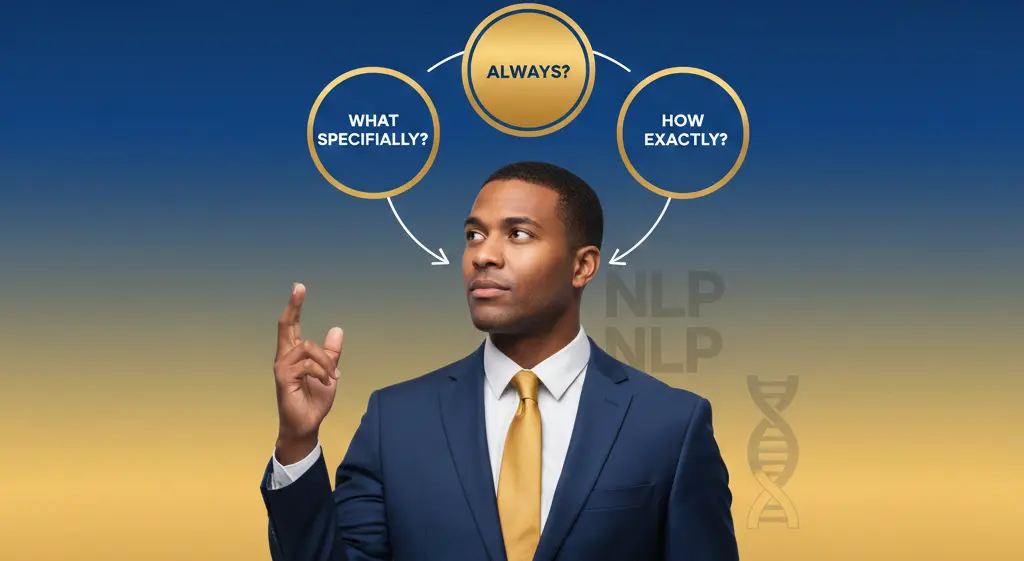
The framework isn’t complicated. Listen for the patterns: missing information, faulty assumptions, sweeping claims. Ask the questions: What specifically? Always? How exactly does that work? The transformation happens not because the questions are complex but because they’re precise and most people never ask them.
Your next project brief, your next performance review, your next strategic planning session, you now have the tools to make them dramatically more effective. The question is whether you’ll actually use them. Most leaders won’t. They’ll read this, think “that makes sense,” and then continue accepting vague language because it feels uncomfortable to push for precision.
The leaders who master Meta Model questioning don’t just communicate better, they think better, decide better, and execute better. Their teams don’t waste time guessing what’s expected. Their projects don’t derail from unclear requirements. Their strategy doesn’t fail because nobody challenged faulty assumptions.
Your team is already talking. The question is whether that talk creates clarity or confusion. Whether those conversations move work forward or spawn three different interpretations that move in three different directions. Whether your organization pays the trillion-dollar tax on poor communication or develops the precision that gives you a competitive advantage.
Unleash your potential to communicate with surgical precision. The Meta Model isn’t just about asking better questions; it’s about building an organization where clear thinking and clear communication are normal, not exceptional.
Ready to transform how your organization communicates? Our NLP Practitioner Certification gives you the complete communication toolkit, including advanced Meta Model training and the frameworks that turn corporate leaders into master communicators. Learn the patterns that eliminate communication waste and drive measurable business results.
Explore our Leadership Training programs to bring these skills to your entire leadership team, or discover how our Corporate Keynote Speaking can introduce these transformative communication skills to your organization in a high-impact format that creates immediate change.